
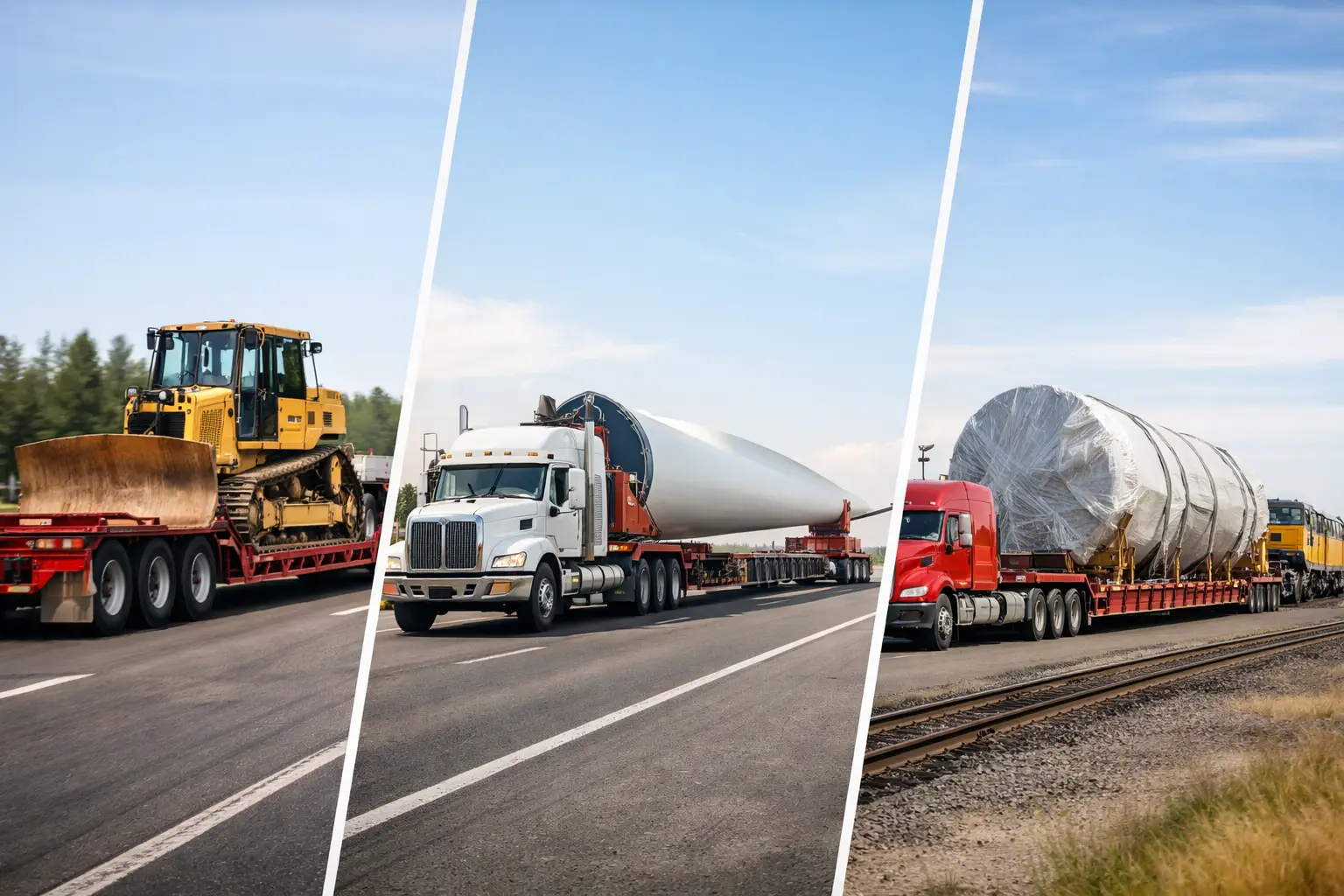
A shipment can be overweight without being excessively wide, or tall enough to create bridge and clearance issues while remaining relatively light. That distinction is why the best equipment for oversized loads is never selected by weight alone. Trailer choice must match the freight’s dimensions, center of gravity, loading requirements, route restrictions, and delivery-site conditions.
For manufacturers, construction suppliers, and industrial shippers, the right equipment protects more than the cargo. It affects permit requirements, available carrier capacity, transit timing, escort needs, and total transportation cost. A trailer that appears economical at booking can become the expensive choice if it creates avoidable routing limits or requires difficult loading and unloading.
Start With the Shipment, Not the Trailer
Oversized freight planning begins with accurate cargo details. Length, width, height, gross weight, axle weight distribution, and center of gravity are all required before a carrier can recommend equipment. Photos, drawings, loading points, and securement requirements also help determine whether the freight can travel safely and legally.
A machine that weighs 45,000 pounds may fit on several trailer types. If it is 12 feet wide, however, permit requirements and route planning become central to the move. If it is tall, deck height may matter more than overall trailer capacity. If it cannot be driven, lifted, or loaded from the rear, the loading method may eliminate otherwise suitable options.
The destination matters as well. A lowboy may be the right choice for transport, but a jobsite with limited turning space or uneven ground may require a different trailer configuration, specialized loading support, or a scheduled delivery window. Equipment decisions should account for the full move, from pickup access to final unloading.
Best Equipment for Oversized Loads: Core Trailer Options
Step Deck Trailers
Step deck trailers, also called single-drop trailers, have an upper deck and a lower deck. Their lower deck provides more height clearance than a standard flatbed, making them a practical choice for freight that is too tall for a legal flatbed load but does not require the lowest possible deck height.
They are commonly used for crated machinery, steel components, construction materials, industrial equipment, and large skids. Step decks are often a strong middle-ground option: they offer more flexibility than a standard flatbed without the loading complexity or cost associated with a lowboy.
The trade-off is that the transition between deck levels can limit how certain freight is positioned. Long equipment, concentrated axle weights, and unusual loading patterns need to be reviewed carefully before dispatch.
Double-Drop and Lowboy Trailers
Double-drop trailers have a lower well between the front and rear deck sections. Lowboy trailers are designed for especially tall or heavy equipment and typically sit closer to the ground than other open-deck options. Many lowboys use removable goosenecks, allowing equipment to be driven or loaded onto the trailer from the front.
This equipment is often used for excavators, loaders, cranes, agricultural machinery, transformers, large generators, and other heavy industrial units. The lower deck height can make the difference between a manageable permitted move and a route that is restricted by overhead clearances.
Lowboys are not a default solution for every large shipment. Their capacity, axle configuration, and loading approach must match the cargo. They can also be more difficult to source during periods of high construction or energy-sector demand. When the shipment requires a lowboy, early planning improves both capacity access and permit timing.
Extendable Flatbeds and Stretch Step Decks
When length is the primary challenge, extendable equipment is often the better fit. Extendable flatbeds and stretch step decks can accommodate long freight such as beams, pipe, wind-energy components, bridge materials, fabricated steel, and industrial assemblies.
A standard flatbed may handle a long item if it remains within legal overhang rules, but that is not always the most efficient or compliant option. Stretch trailers distribute the load across a longer deck and can reduce the need for extreme overhang. They also provide more securement positions for freight that requires multiple tie-down locations.
Extended equipment has operational limits. Tight facilities, urban delivery points, and sharp turns can create challenges for long trailers. Route review should consider turning radiuses, staging space, and whether the receiver can safely accommodate the trailer length.
Multi-Axle and Heavy-Haul Configurations
Some oversized loads are primarily a weight problem. Multi-axle trailers, including 3+3, 4-axle, 9-axle, and specialized heavy-haul configurations, distribute weight across more axles to meet state or provincial requirements and protect roads and bridges.
These configurations are used for extremely heavy machinery, industrial presses, large transformers, mining equipment, and modular components. The trailer selection is closely tied to axle weights, not just total gross weight. A shipment may be within the trailer’s total capacity while still exceeding allowable weight on a specific axle group.
Heavy-haul moves require detailed engineering and coordination. Depending on the route, they may involve permit applications, bridge studies, pilot cars, police escorts, travel-hour restrictions, and staged delivery. The most suitable equipment is the configuration that keeps axle weights compliant while remaining practical for the origin and destination.
RGNs and Specialized Detachable Trailers
Removable gooseneck trailers, commonly called RGNs, are designed for equipment that can be driven or rolled onto the deck. The front section detaches, creating a ramp for loading. This removes the need for cranes in many situations and can improve safety and efficiency for wheeled or tracked equipment.
RGNs are a common choice for bulldozers, excavators, pavers, drilling equipment, and other self-propelled machinery. The available deck length, well depth, and axle configuration vary by trailer, so equipment dimensions and operating weight still need to be confirmed in advance.
Not every piece of machinery is suitable for RGN loading. Ground clearance, ramp angle, tire condition, machine operability, and loading-site space can all affect feasibility. A non-operational unit may require crane loading or a different trailer design.
Open Deck, Conestoga, or Enclosed Service?
Oversized freight does not always require an open trailer. Some high-value machinery, sensitive components, or large crated freight may need weather protection in addition to specialized dimensions. In those cases, a Conestoga or specialized enclosed solution may be appropriate if the cargo fits within the equipment’s interior limits.
Open-deck equipment remains the standard for many over-dimensional moves because it allows side, rear, top, crane, or drive-on loading. It also gives carriers more flexibility when handling freight that exceeds normal height or width. The trade-off is exposure to weather and the need for tarping when required.
Tarping should be discussed before equipment is assigned. Oversized freight may need custom tarps, additional labor, or special securement methods. It is not an automatic service on every open-deck shipment, particularly when the cargo shape makes tarp installation unsafe or impractical.
Route, Permits, and Cross-Border Requirements Shape the Decision
The correct trailer is only one part of an oversized move. Each state, province, and municipality may apply different limits for dimensions, weight, escort requirements, travel times, and permit processing. A configuration that works for a domestic lane may need adjustment for a cross-border move between the United States and Canada.
Height is especially route-sensitive. Bridge clearances, utility lines, construction zones, and seasonal restrictions can change the available path. Width and length can trigger escort requirements, while weight can require route-specific approval based on bridge capacity. Accurate shipment information prevents permits from being issued for the wrong configuration.
For cross-border freight, shippers should also prepare complete commercial documentation and ensure commodity descriptions, values, and equipment details are consistent across shipping and customs documents. A border delay can disrupt a planned delivery appointment, particularly when escorts or restricted travel windows are involved.
Build Time Into the Transportation Plan
Oversized capacity is not always available on demand. Specialized trailers are limited, and qualified drivers with heavy-haul experience may be scheduled well in advance. Permit processing can also range from relatively quick to highly involved, depending on the load and jurisdictions involved.
Early planning creates options. It allows the logistics team to compare equipment configurations, assess routing, secure permits, schedule loading support, and coordinate the receiver. It also reduces the risk of paying for avoidable rework, such as reloading cargo after the assigned trailer proves unsuitable.
Midemide Logistics coordinates specialized and oversized freight across U.S. and Canadian lanes with equipment selection tied to the shipment’s actual operating requirements. The goal is not simply to find a trailer, but to build a workable transportation plan around the freight, the route, and the delivery conditions.
The most reliable oversized move begins with complete dimensions and ends with equipment that fits the real-world route. Provide those details early, and the transportation plan can be built around execution instead of last-minute compromises.