
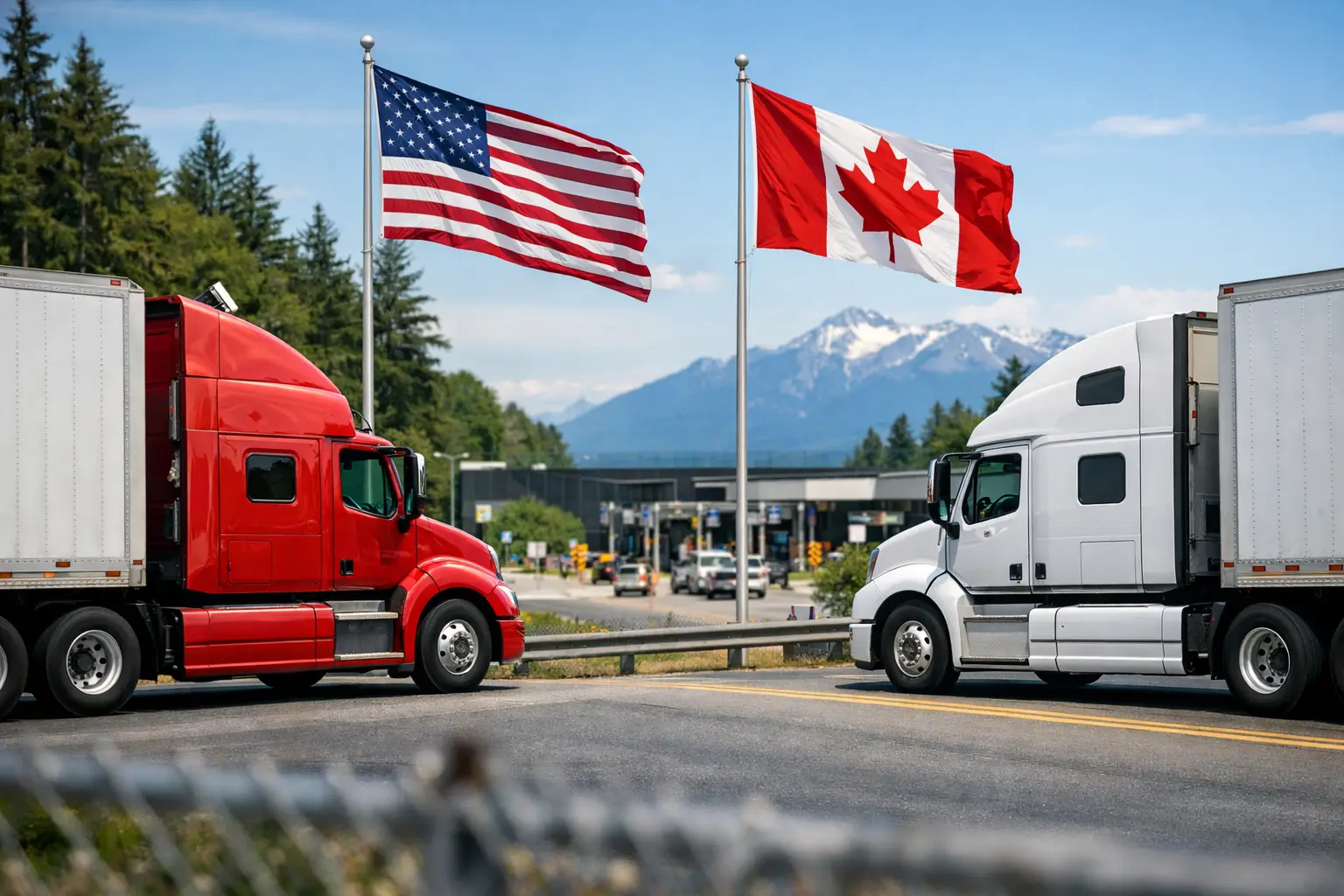
A truck can be loaded, dispatched, and on schedule for a border crossing only to stop because the commercial invoice does not match the entry data, the importer is not ready to account for duties and taxes, or a regulated commodity was not identified early enough. Canada US freight rules are not a single checklist. They are a set of customs, carrier, tax, and product-specific requirements that must align before freight reaches the border.
For manufacturers, distributors, wholesalers, and construction suppliers, the operational goal is straightforward: make border clearance part of freight planning, not a problem handed to the driver at the crossing. The strongest process starts when the order is released, with clear ownership of classification, customs filing, documents, and delivery instructions.
Canada US Freight Rules Start With the Transaction
Every cross-border shipment has two distinct sides: export from one country and import into the other. A shipment moving from Ontario to Tennessee, for example, must meet Canadian export and U.S. import requirements. The reverse move requires U.S. export compliance and Canadian import processing. The same freight may need different data, filings, and release procedures depending on direction.
The importer of record carries primary responsibility for the accuracy of the customs declaration, duties, taxes, and compliance of the imported goods. A customs broker can prepare and submit entries, but the importer remains accountable for the information provided. Shippers should confirm the importer of record before pickup, especially when goods are sold through distributors, consigned to a jobsite, or shipped under complex Incoterms.
The commercial invoice is the foundation of the customs transaction. It should clearly state the seller, buyer, consignee, importer of record where applicable, detailed product description, quantity, unit value, total value, currency, country of origin, and terms of sale. Vague descriptions such as parts, samples, or equipment invite questions and can delay release. A description should explain what the product is, what it is made of, and its intended use when that context affects classification.
A bill of lading and packing list support the physical movement of freight, but they do not replace a complete commercial invoice. The shipment details across all documents must match. Differences in piece count, weight, consignee name, product description, or value can create avoidable border holds.
Classification, Origin, and Value Drive the Entry
The Harmonized System tariff classification determines the duty treatment and may trigger product-specific controls. Classification is more than selecting a general product category. Material composition, function, end use, dimensions, and manufacturing details can all affect the tariff code. For repeated product lines, businesses should maintain a documented classification file rather than making a new judgment with each shipment.
Country of origin is equally important and is not always the country from which freight ships. Origin generally relates to where the goods were produced or substantially transformed. A product shipped from a Canadian warehouse may still have an origin in another country. Incorrect origin declarations can affect duty calculations, trade remedy exposure, marking requirements, and eligibility for preferential treatment.
The United States-Mexico-Canada Agreement can reduce or eliminate duty on qualifying goods, but it does not automatically apply simply because freight moves between Canada and the United States. The goods must meet the applicable rules of origin, and the importer must have valid certification information to support the claim. There is no single mandatory CUSMA certificate form, but the certification must contain the required data elements and be available if customs requests support.
Declared value also requires disciplined control. Customs value is generally based on the transaction value, with specific rules for additions such as assists, royalties, packing, and certain transportation costs. Discounts, no-charge replacements, warranty shipments, samples, and transfers between related companies may need special handling. When the sale price is not straightforward, involve the customs broker or trade compliance team before the freight is tendered.
Electronic Filing Must Match the Freight Plan
Advance cargo information is central to cross-border truck freight. Carriers moving commercial cargo into Canada use the Canada Border Services Agency electronic systems, commonly referred to in operations as ACI eManifest. Freight moving into the United States is generally transmitted through U.S. Customs and Border Protection's ACE system. The carrier, customs broker, and importer each have connected responsibilities, and timing matters.
A carrier needs accurate shipment data early enough to transmit cargo information and receive any required acceptance or release status before arrival. Late changes to consignee information, commodity descriptions, weights, or shipment references can require corrections in the customs and carrier systems. That is why a last-minute pickup request may be feasible for transportation capacity but still unsuitable for a time-sensitive border move.
For Canadian imports, the CBSA Assessment and Revenue Management program, known as CARM, has changed how many importers manage financial security and payment responsibilities. Importers should confirm their CARM account setup, delegation arrangements, and broker access before goods arrive. Freight cannot solve an importer account or payment readiness issue at the border.
For U.S. imports, customs entry requirements vary based on the commodity, value, intended use, and other factors. A customs broker can advise on entry type, bond requirements, and government agency filings. The practical point for shippers is to identify the customs broker and provide complete documents before dispatch, not after a driver is waiting at the port of entry.
Product Rules Can Override a Standard Freight Workflow
A palletized shipment is not necessarily a simple shipment. Food, beverages, medical products, cosmetics, chemicals, wood packaging, agricultural goods, plants, animal products, steel, aluminum, and controlled technology can all involve additional agencies, permits, notices, labeling, or admissibility requirements.
For example, food moving into the United States may require Food and Drug Administration-related information and advance notice. Certain agricultural materials can be subject to U.S. Department of Agriculture controls. Wood packaging material used for international shipment must meet applicable treatment and marking requirements. Dangerous goods add another layer, requiring correct classification, packaging, marks, labels, shipping papers, and carrier acceptance.
Oversized machinery, flatbed loads, and project freight create a different set of issues. Customs clearance is only one part of the plan. The shipment may also require permits, route review, escorts, securement planning, dimensional confirmation, and delivery-site coordination. A Conestoga may protect freight that needs side loading and weather coverage, while an open-deck flatbed may be necessary for a load that cannot fit through a trailer door. Equipment selection should be made alongside the compliance review, not after freight is ready to load.
Carrier Compliance Matters Beyond the Border
The carrier must be properly authorized, insured, and equipped for the lane and cargo. Drivers need valid credentials and must have the shipment references and documents required for the crossing. Motor carriers also operate under hours-of-service rules, but those rules can differ between Canada and the United States. Dispatch plans should account for the jurisdiction, crossing location, appointment time, and the possibility of a secondary inspection.
Cabotage is another common planning concern. In general, a foreign carrier cannot use a cross-border movement as a way to perform domestic point-to-point freight transportation within the other country. A Canadian carrier may deliver an international shipment in the United States, and a U.S. carrier may deliver an international shipment in Canada, but adding domestic legs requires careful review. This is especially relevant when a shipment has multiple stops, jobsite deliveries, or a return load opportunity.
Shippers should also verify cargo insurance expectations and claim procedures. Standard carrier liability may not reflect the full value of specialized equipment, high-value products, or time-critical components. The right coverage and declared-value strategy depend on the commodity, mode, contract terms, and consequences of delay.
Build a Release-Ready Shipment Process
Reliable cross-border execution comes from a repeatable handoff between sales, shipping, trade compliance, the customs broker, and the transportation provider. Before a load is assigned, confirm the importer of record, broker contact, tariff classification, origin, value, Incoterms, delivery location, commodity restrictions, and required equipment. Then provide final shipment details early enough for electronic filing and route planning.
A practical exception process is just as valuable. If quantities change after loading, a consignee changes, a shipment splits, or freight is refused at delivery, the team should know who can authorize document corrections and customs updates. Treating these events as standard operational scenarios keeps a small change from becoming a border delay.
Midemide Logistics coordinates cross-border transportation with the same focus applied to dedicated, flatbed, Conestoga, straight-truck, final-mile, and specialized freight: match the shipment requirements to the equipment, capacity, documentation timing, and delivery plan. For a business moving regular Canada-U.S. lanes, that coordination reduces unnecessary handoffs and gives operations teams a clearer path from pickup through release and final delivery.
Before the next cross-border load is tendered, review the transaction data with the same care given to the trailer type and delivery appointment. The border usually performs best when the shipment is already release-ready before the wheels start moving.