
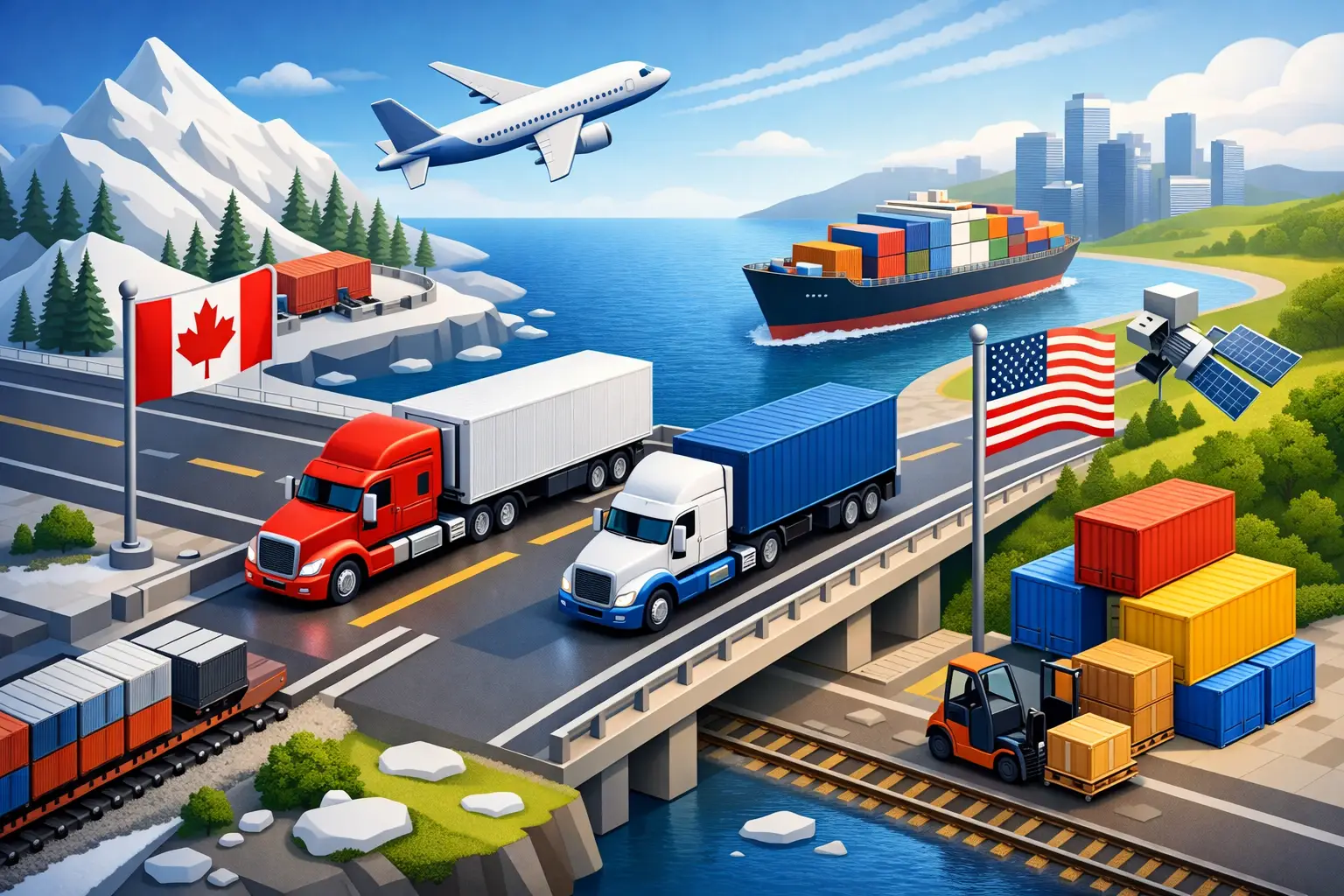
A late pickup in Ohio can turn into a missed delivery in Ontario faster than most teams expect. When freight crosses an international border, small execution gaps compound quickly. That is why cross border logistics Canada is not just a transportation task. It is an operational discipline that affects transit time, inventory flow, customer performance, and total landed cost.
For shippers moving freight between the US and Canada, the real challenge is not finding a truck once. It is building a repeatable process that holds up under appointment pressure, customs requirements, equipment constraints, seasonal volume swings, and shipment exceptions. The companies that manage this well usually have the same advantage: they treat cross-border freight as a coordinated system, not a series of disconnected loads.
What cross border logistics Canada actually requires
Domestic freight planning does not fully prepare a shipper for international execution. The lane may be short in miles, but it carries additional coordination points that affect both speed and reliability. Documentation accuracy, customs handoff, border timing, commodity classification, equipment selection, and consignee scheduling all matter at the same time.
That is why cross border logistics Canada tends to reward partners that can manage more than booking capacity. A strong provider needs to understand how freight mode, cargo type, shipment urgency, and delivery requirements interact. A standard palletized shipment moving to a distribution center is one thing. An oversized load, a flatbed move, a final-mile commercial delivery, or a time-sensitive straight truck shipment is another.
The work is operational, not theoretical. If the freight is loaded on the wrong equipment, if the paperwork does not match the cargo, or if delivery timing is not aligned with receiver constraints, the border simply exposes the weakness faster.
The main pressure points for cross-border freight
Most shipping problems on US-Canada lanes come from a few recurring issues. Capacity is one. Border-ready equipment is not always interchangeable, especially when freight requires flatbed, Conestoga, specialized securement, or dedicated transportation. Documentation is another. A shipment can be physically ready and still lose time if commercial records are incomplete or inconsistent.
Transit variability is also a common issue. Border conditions, inspection timing, weather, and terminal congestion can shift an otherwise stable lane. This does not mean cross-border shipping is unpredictable. It means planning has to account for variability instead of assuming every load will behave like a domestic run.
Then there is delivery complexity on the receiving side. Some Canada-bound shipments do not end at a simple dock. They may require appointment-based final-mile delivery, jobsite coordination, limited access handling, or equipment capable of protecting freight in transit and unloading at nontraditional locations. In these cases, the border is only one part of the job.
Choosing the right mode for the lane
Mode selection has a direct effect on service performance. It also affects cost control in ways that are often overlooked. A shipper focused only on base rate can end up paying more through delays, rehandling, missed appointments, or poor equipment fit.
Truckload and dedicated transportation make sense when volume is consistent, delivery windows are narrow, or service control is a priority. Dedicated capacity can be especially useful for manufacturers and distributors that need repeatable cross-border performance on fixed lanes. It reduces variability and simplifies planning.
Straight truck delivery can be the right option for expedited or high-priority shipments that need direct transit and reduced handling. For urgent parts, commercial replenishment, or freight tied to production schedules, speed and control often matter more than squeezing every dollar from the linehaul.
Flatbed and Conestoga service are critical when freight dimensions, loading method, or site conditions rule out a dry van. Construction-related shippers, industrial suppliers, and project freight teams often need equipment that matches the cargo, not the other way around. Specialized and oversized freight adds another layer. These moves require permit awareness, route planning, and close coordination well before pickup.
The right answer depends on the shipment. A flexible logistics partner should not force every move into one model. It should match the mode to the service requirement.
Why customs coordination affects delivery performance
Shippers sometimes separate transportation from customs planning as if they operate independently. In practice, they are tightly connected. Freight can only move as efficiently as the supporting information allows.
Product details, values, origin data, consignee information, and shipment records need to align before the truck reaches the border. When they do not, transit time suffers. Even when a problem is resolved the same day, the downstream impact can still include appointment misses, warehouse labor disruptions, and customer service escalations.
This is why disciplined pre-shipment review matters. Cross-border execution works better when freight teams confirm shipment data early, flag commodity-specific requirements in advance, and coordinate timing with all parties involved. A carrier or brokerage partner should be part of that process, not reacting after the fact.
Visibility matters, but response matters more
Most shippers now expect shipment tracking, status updates, and basic milestone visibility. That is standard. What separates strong logistics support from average support is what happens when a load moves off plan.
If a truck is delayed at pickup, held at the border, or running late to a receiver, the important question is not whether someone can report the issue. The important question is whether someone can manage the next step quickly. That may mean adjusting delivery appointments, coordinating with the consignee, reallocating equipment, or building a recovery plan that limits disruption.
Execution teams need practical visibility, not just data feeds. Operations leaders care about accurate updates because updates support decisions. They do not solve a problem by themselves.
One partner versus multiple providers
There are situations where using several providers makes sense, especially when a shipper runs highly segmented freight programs. But for many businesses, fragmentation creates avoidable friction. One provider handles standard truckload, another handles flatbed, another handles final mile, and a separate group manages urgent freight. Over time, communication gaps appear and accountability becomes harder to pin down.
A consolidated logistics partner can simplify that environment. When one team can manage standard freight, dedicated transportation, specialized equipment, final-mile delivery, and supply chain support across US-Canada lanes, coordination gets tighter. Handoffs are reduced. Exception management is faster. Service standards are easier to maintain.
That does not mean every shipper should centralize everything immediately. It depends on shipment profile, internal systems, and current provider performance. But when cross-border freight includes a mix of routine and complex moves, consolidation often improves control.
Building a stronger cross border logistics Canada process
Shippers usually improve cross-border performance by tightening a few fundamentals. First, align mode and equipment with the cargo and delivery environment. Second, verify shipment data before pickup rather than troubleshooting at the border. Third, build realistic transit plans that account for variability instead of assuming best-case timing.
It also helps to review recurring exceptions by lane, consignee, commodity type, and equipment class. Patterns show up quickly when teams look at the data operationally. A shipment that is late once may be an isolated issue. A shipment profile that repeatedly causes delays usually points to a planning problem that can be fixed.
For companies moving a mix of palletized freight, industrial materials, oversized loads, and location-sensitive deliveries, the most effective setup is often a logistics partner with both brokerage reach and asset-based logistics capability. That combination improves optionality. It can provide broader capacity access while also giving the shipper more control in time-sensitive or service-critical situations.
This is where a provider such as Midemide Logistics can fit operationally. A shipper that needs cross-border coverage, dedicated support, specialized equipment, final-mile capability, and day-to-day execution under one roof is usually looking for less friction, not more vendor management.
What reliable cross-border performance looks like
Reliable service is not just a truck showing up. It is consistent pickup execution, documentation discipline, equipment fit, proactive communication, and delivery follow-through. It is also the ability to handle exceptions without turning every issue into a customer problem.
For manufacturers, distributors, retailers, and industrial shippers, that reliability protects more than freight. It protects production schedules, inventory availability, project timelines, and customer commitments. On US-Canada lanes, those outcomes depend on planning depth and execution control as much as transportation capacity.
The strongest cross-border operations are usually not the loudest. They are the ones that move freight with fewer surprises, faster responses, and better alignment between planning and delivery. If your shipping network depends on freight crossing the border consistently, the better question is not whether you can move the load. It is whether your current process can support the business when the load is routine, urgent, oversized, or off plan.