
A load can fit within a trailer's weight capacity and still be the wrong shipment for the equipment. Freight height, loading method, center of gravity, and permit exposure often decide whether a standard flatbed or step deck is the practical choice. When comparing flatbed versus step deck trailers, the objective is not to select the most specialized option. It is to select equipment that moves the load safely, legally, and with the fewest avoidable constraints.
Flatbed Versus Step Deck Trailers: The Core Difference
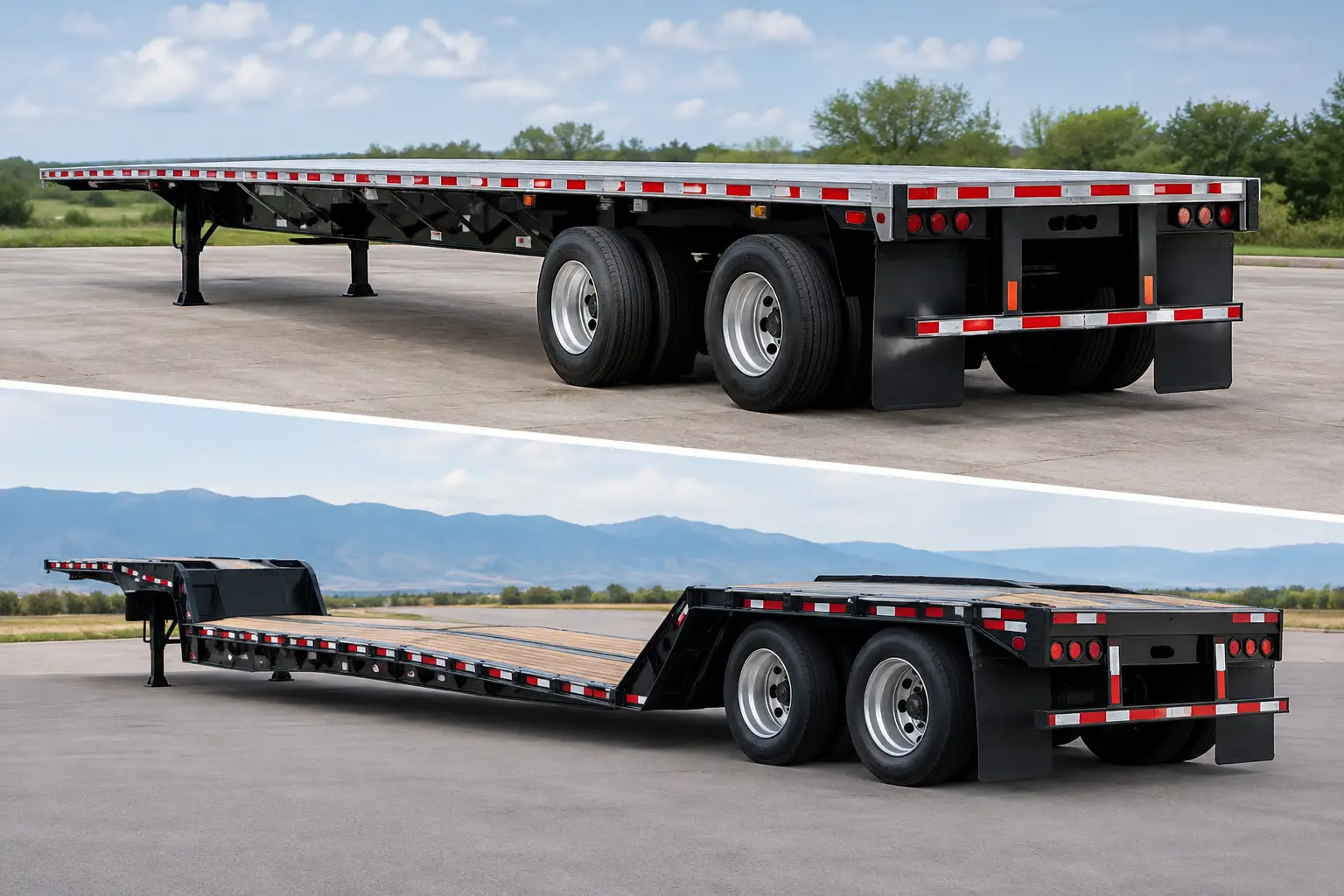
A standard flatbed has a single, level deck running from the front of the trailer to the rear. Most standard units are 48 or 53 feet long and 102 inches wide, with a deck height commonly around 60 inches from the ground. This design provides open access from both sides, the rear, and often the top, making flatbeds a practical choice for freight that can be loaded by forklift, crane, or dock equipment.
A step deck, also called a drop deck, has two deck levels. The upper deck sits over the tractor's rear wheels, then drops behind the trailer's gooseneck to a lower main deck. The lower deck is commonly about 36 to 42 inches high, creating additional vertical clearance for tall freight.
That lower deck is the primary reason to use a step deck. In many jurisdictions, the usual maximum loaded height is 13 feet 6 inches without an oversize permit, although limits and enforcement conditions can vary by route. A load that is too tall for a flatbed may remain within legal height on a step deck. That can eliminate permit requirements, route restrictions, pilot-car needs, and scheduling delays.
When a Flatbed Is the Better Fit
Flatbeds are usually the efficient choice when freight is within standard height limits and requires broad loading access. Steel products, lumber, palletized building materials, pipe, fabricated components, machinery with a manageable profile, and bundled industrial goods frequently move well on a flatbed.
The level deck simplifies load placement. A shipper can position freight across the trailer without accounting for a deck transition, and loaders have more usable length for consistent freight dimensions. This matters for shipments such as long structural materials, uniform skids, or multiple pieces that need to be spread evenly for weight distribution.
Flatbeds can also offer more straightforward capacity sourcing on common freight lanes. For standard open-deck freight, a wider carrier pool may support better scheduling flexibility and competitive pricing. That does not mean a flatbed is always less expensive in total. If a tall load creates permit exposure or requires a route workaround, the apparent equipment savings can disappear quickly.
A flatbed is not automatically the right answer simply because a load is not oversized. Shippers should confirm the loaded height from the actual deck, not only the product dimensions. Cradles, dunnage, blocking, securement hardware, and tire clearance can add inches that change the equipment decision.
When a Step Deck Is the Better Fit
Step decks are designed for freight that needs more vertical room without moving to a lowboy or other specialized trailer. Common examples include tall machinery, tanks, agricultural equipment, electrical equipment, industrial skids, preassembled components, and construction materials that would exceed legal height on a standard flatbed.
The main deck's lower height can create a major operational advantage. For example, a piece of equipment measuring 10 feet 6 inches tall may be too high once placed on a standard flatbed deck. On a step deck, it may remain below the typical 13-foot-6-inch threshold, depending on dunnage and securement requirements.
However, the lower deck comes with trade-offs. The main deck is shorter than the overall trailer length because the upper deck occupies the front section. Freight must be planned around both the length of the lower deck and the height available beneath the trailer's rear structure. A shipment with several long, uniform pieces may fit more naturally on a flatbed, even if one piece is tall enough to suggest a step deck.
Step decks may also be equipped with ramps, which can support drive-on or roll-on loading for certain machinery. Ramp availability, ramp angle, equipment ground clearance, axle placement, and loading-site conditions must be verified in advance. A ramped step deck is not a substitute for a detailed loading plan.
Height Is Only One Part of Equipment Selection
Trailer choice should begin with complete freight specifications. Dimensions, weight, piece count, loading method, and delivery conditions all affect whether a shipment can move safely and efficiently.
Weight distribution is particularly important. Both flatbeds and step decks can carry substantial payloads, but legal capacity depends on axle weights, trailer configuration, commodity density, and the location of the load. A compact, heavy machine may fit physically on either trailer while still requiring careful axle positioning. Loading it too far forward or too far rearward can create a compliance issue before the truck leaves the facility.
Center of gravity also deserves attention. Tall freight on a step deck often benefits from the lower deck because it sits closer to the ground. That can improve stability compared with loading the same item on a higher flatbed deck. Still, a low deck does not remove the need for proper blocking, bracing, and securement.
Loading access can be equally decisive. Flatbeds provide clear side access for forklift loading and crane placement. Step decks retain open-deck access, but the upper and lower deck arrangement can limit where forklifts can place certain pieces. If a facility has limited loading space, an overhead obstruction, or no dock-level equipment, the loading plan should be confirmed before tendering the shipment.
Securement and Freight Protection Requirements
Both trailer types are open-deck equipment, which means cargo is exposed to weather, road debris, and changing conditions. Securement must comply with applicable cargo rules and reflect the freight's shape, weight, and movement risk. Chains, binders, straps, edge protection, dunnage, blocking, tarps, and corner protectors may all be part of the shipment plan.
A flatbed can be easier to tarp when freight has a uniform profile. Step deck loads may require more planning because the deck transition and varied load heights can create tarp gaps or stress points. Freight that needs open-deck access but also requires weather protection may be better suited to a Conestoga, depending on dimensions, loading method, and lane availability.
Shippers should also account for securement space when measuring a shipment. A machine may be 8 feet wide on paper, but attachment points, overhang, protective materials, or required chain angles may affect how it can be positioned. Accurate dimensions prevent last-minute rework at pickup.
Permits, Routes, and Cross-Border Planning
A load that exceeds legal height, width, length, or weight can trigger permits and route-specific restrictions. Height is often the concern in a flatbed-versus-step-deck decision, but other dimensions can create the same need for additional planning. Bridges, power lines, construction zones, curfews, and state or provincial regulations can all influence the route.
For cross-border shipments between Canada and the United States, equipment planning should happen early. A load that is legal in one jurisdiction may face different dimensional limits or permit processes in another. Documentation, appointment timing, customs coordination, and permit lead times should be aligned with the transportation plan rather than handled after the truck is assigned.
This is where a logistics partner can add value beyond finding a truck. Midemide Logistics helps shippers match freight requirements with appropriate capacity while coordinating domestic and cross-border moves that require closer equipment, routing, and delivery planning.
Questions to Answer Before Booking
Before selecting either trailer type, confirm the freight's exact length, width, height, and weight as loaded. Include skids, crating, dunnage, lifting lugs, attachments, and any packaging that changes the final dimensions.
Also confirm whether the freight can be loaded from the side, rear, or top; whether it can be driven onto ramps; and whether the pickup and delivery sites have the equipment and space to handle the trailer. Finally, identify any deadline, permit, weather-protection, or cross-border requirements that could affect capacity or transit time.
A step deck is often the right answer when height is the issue. A flatbed is often the more efficient answer when the freight is standard height and benefits from a full, level deck. The strongest equipment decision comes from planning the complete shipment, not just matching a trailer to one dimension. Share complete specifications early, and the transportation plan can be built around legal clearance, secure loading, and dependable delivery.