
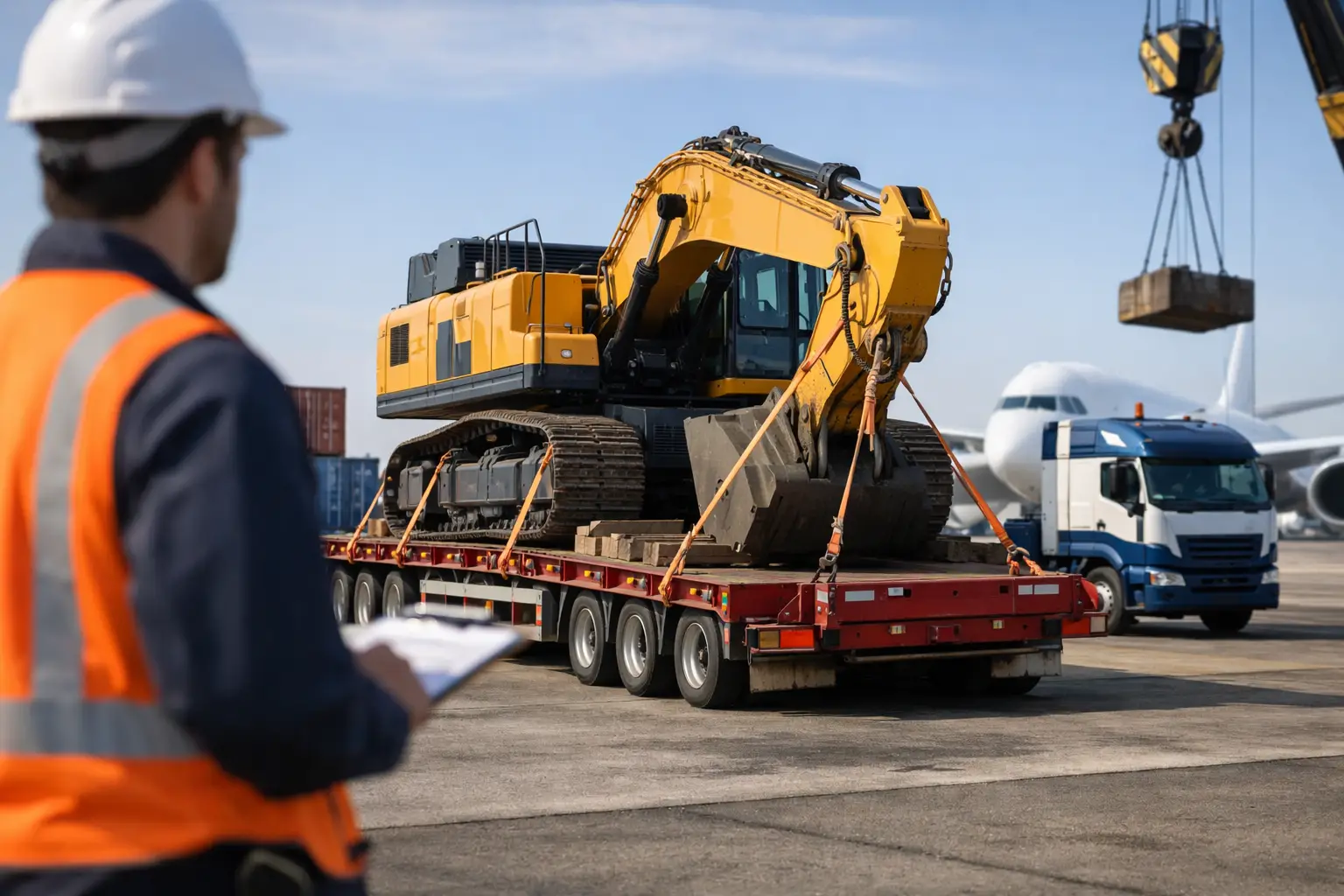
A shipment can be ready at the dock, properly packaged, and scheduled with a carrier, yet still fail to move if its dimensions do not match the route, permit, or equipment plan. Knowing how to ship oversized freight means treating the move as an engineered transportation project, not a standard truckload booking. The dimensions, weight distribution, pickup conditions, destination access, and jurisdictional rules all affect whether the freight can move safely and on schedule.
For manufacturers, construction suppliers, industrial distributors, and equipment shippers, the objective is simple: secure the right capacity and approvals before the shipment becomes a production or customer-service problem. That requires early planning, accurate freight data, and coordination across every point in the move.
What Makes Freight Oversized?
Oversized freight is cargo that exceeds legal limits for width, height, length, weight, or axle configuration on a planned route. Those limits are not universal. They can vary by U.S. state, Canadian province, municipality, road type, bridge restriction, and the specific permit issued for the shipment.
A load may be legal in one jurisdiction but require an oversize or overweight permit in the next. A machine that fits on a standard flatbed may still need special routing because of its height or because its weight concentration affects bridge clearances. This is why the equipment itself is only one part of the decision.
Common examples include construction machinery, agricultural equipment, transformers, steel structures, industrial tanks, prefabricated components, large generators, and long or heavy manufacturing assemblies. Some shipments are visibly oversized. Others appear manageable until the loaded dimensions, axle weights, or delivery-site constraints are reviewed.
How to Ship Oversized Freight: Start With Accurate Data
The strongest oversized freight plan begins with a complete and verified load profile. Do not rely on estimated weights, catalog dimensions, or empty-equipment specifications. Measure the freight after it is prepared for transport, including skids, crating, protective materials, attachments, and any overhang.
Provide the transportation team with the overall length, width, height, and gross weight. Also share the freight's center of gravity, axle or point-load information when available, loading orientation, lifting points, and whether the shipment can be stacked, turned, or partially disassembled. These details determine trailer selection, securement requirements, permit needs, and how the driver can safely position the load.
Pickup and delivery information matters just as much. A carrier needs to know whether there is adequate turning space, a level loading area, loading dock access, crane availability, forklift capacity, and site operating hours. An oversized shipment can be permitted for the highway but still face delays if it cannot physically enter the consignee's facility.
Select Equipment Based on the Load and Lane
Oversized freight is often moved on flatbeds, step decks, double drops, RGNs, multi-axle trailers, stretch trailers, or specialized heavy-haul equipment. The right option depends on more than overall size.
A tall shipment may require a low-deck trailer to remain within height limits. Heavy equipment may need an RGN so it can be driven or winched onto the trailer at ground level. Long freight such as pipe, structural steel, or machinery components may require a stretch trailer. Loads with concentrated weight can require extra axles to distribute the weight in accordance with permit conditions and bridge formulas.
Conestoga equipment can be a practical option for freight that needs weather protection while still loading from the side or overhead. However, it is not a substitute for specialized equipment when the shipment exceeds the trailer's interior dimensions or requires open-deck loading.
The least expensive trailer is not always the lowest-cost transportation choice. Selecting equipment that is too small can lead to a reload, a missed permit window, damaged freight, or a rejected pickup. Selecting equipment that is larger than necessary can add avoidable cost. The best fit balances cargo requirements, legal dimensions, loading conditions, lane availability, and delivery timing.
Plan the Route Before the Truck Is Dispatched
Route planning for oversized freight is not the same as selecting the fastest navigation route. The planned lane must account for bridge ratings, vertical clearances, lane widths, construction zones, utility lines, railroad crossings, restricted roads, and local curfews.
A route that works for a wide load may not work for a tall or overweight load. In some cases, the permitted route requires a longer distance, off-peak movement, or a specific crossing location. That can affect transit time, fuel cost, driver hours, and appointment planning.
Oversized loads may also require pilot cars, escorts, police support, or utility coordination. Requirements vary by jurisdiction and can change based on the dimensions of the loaded vehicle. For example, a load that requires no escort in one state may need front and rear escorts after crossing a state line. Build those requirements into the transportation plan early rather than treating them as last-minute add-ons.
Weather is another operational factor. High winds can restrict some tall or wide loads. Snow, ice, flooding, and roadwork can also change an approved route or suspend movement. For time-sensitive shipments, a realistic delivery window is more reliable than a standard truckload transit estimate.
Permits and Compliance Cannot Be an Afterthought
Most oversized or overweight moves require permits, and the permit process needs accurate shipment and equipment data. Incorrect dimensions, axle spacing, weight distribution, or route information can delay approval or invalidate a permit after dispatch.
Permits may be issued at the state, provincial, county, or municipal level, depending on the route. They can specify travel times, approved roads, escort requirements, maximum speed, signage, lighting, and other operating conditions. The carrier and logistics provider must ensure the truck configuration matches the permit application.
Securement is equally important. Chains, binders, straps, blocking, bracing, and tarps must be appropriate for the commodity and comply with applicable cargo securement rules. Freight that shifts in transit creates a safety issue and can change the loaded dimensions or axle weights, putting the move out of compliance.
Cross-Border Oversized Freight Requires Added Coordination
Shipping between the United States and Canada adds a second layer of planning. The shipment needs correct commercial documentation, clear commodity descriptions, verified values, and coordinated customs processing in addition to transportation permits.
Border timing should be considered alongside permit timing. A load may have authorized travel hours that do not align with a border crossing's operating conditions, escort availability, or delivery appointment. The route also needs to account for the dimensions and weight restrictions at the selected crossing and on the connecting roads.
For cross-border equipment moves, confirm whether the freight is being sold, temporarily imported, returned after repair, or moved for a project. The transaction type can affect customs documentation and clearance requirements. Delays at the border are especially costly when escorts, cranes, jobsite crews, or receiving teams are scheduled at the destination.
Coordinate Loading, Tracking, and Delivery Execution
A sound plan still depends on execution at pickup and delivery. Before loading, confirm that the equipment dispatched matches the plan and that the driver has the permits, route instructions, securement materials, and site contacts needed for the move.
At pickup, inspect the freight dimensions and condition before it is loaded. If the actual load differs from the quoted specifications, stop and reassess. A few inches of additional width or height can change the permit and routing requirements. Document the loaded condition with clear photos and verify securement before departure.
During transit, maintain communication around route changes, weather issues, permit restrictions, and appointment updates. For project freight or jobsite deliveries, coordination should include the receiving crew, unloading equipment, laydown area, and any access controls. The delivery cannot be considered successful until the freight is safely positioned where the customer needs it.
Use a Logistics Partner That Can Manage the Details
Oversized freight moves involve multiple dependencies, from specialized carrier capacity and permits to routing, escorts, loading requirements, and cross-border documentation. Working with one logistics partner helps reduce handoffs and gives operations teams a clear point of accountability.
Midemide Logistics coordinates specialized and oversized freight across the United States and Canada, matching equipment and transportation planning to the shipment's actual requirements. For shippers managing a mix of standard, heavy-haul, flatbed, and cross-border freight, that coordination can simplify daily execution without treating complex loads as exceptions.
The most reliable oversized shipment is the one planned before production is complete and before equipment arrives at the dock. Start with verified dimensions, involve transportation specialists early, and give routing and permits the same attention as the freight itself. That preparation protects delivery schedules when the load leaves no room for assumptions.