
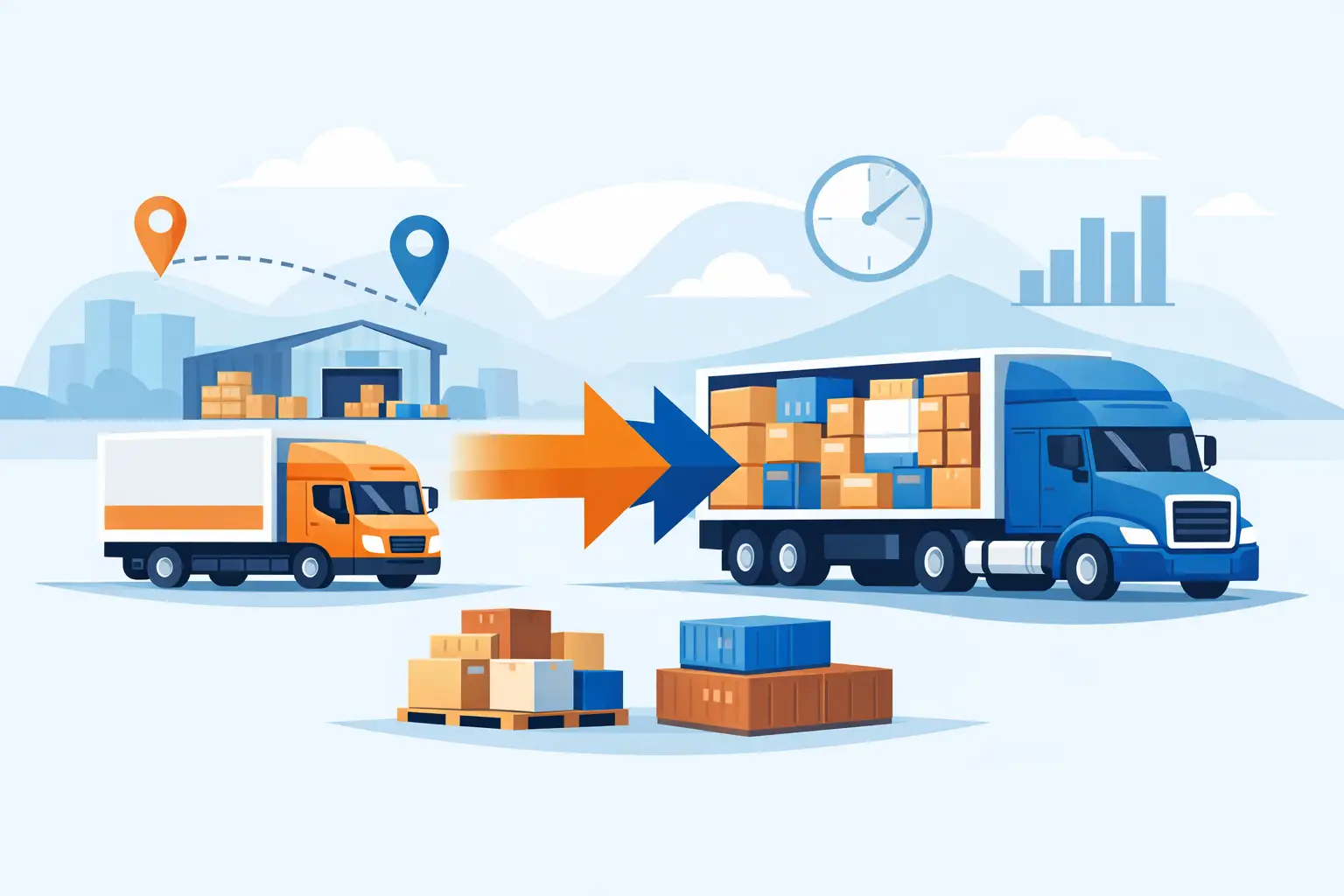
A trailer leaving half empty can create the same delivery obligation as a full load, but at a much higher cost per pallet. LTL and consolidation are methods of optimizing truck space and cost per shipment when freight volumes do not justify reserving a full trailer. For shippers moving across the United States, Canada, or cross-border lanes, selecting the right model affects freight spend, delivery consistency, handling exposure, and the amount of coordination required from the operations team.
Neither option is automatically the lowest-cost choice. The best approach depends on shipment size, freight characteristics, pickup and delivery windows, lane density, and how much control the shipper needs over transit. Understanding where LTL ends and consolidation begins helps teams make more practical transportation decisions.
How LTL Freight Uses Available Capacity
Less-than-truckload freight, commonly called LTL, is designed for shipments that occupy only a portion of a trailer. Multiple shippers' freight moves through a carrier network, with each customer paying for the space, weight, freight class, and service requirements associated with their shipment.
An LTL shipment may move through one or more terminals before final delivery. The carrier collects freight from the shipper, sorts it through its network, combines it with other freight moving in a similar direction, and dispatches it for delivery. This network structure gives businesses access to transportation capacity without paying for an entire truck.
LTL is often a practical fit for palletized freight that moves regularly but in lower volumes. A distributor replenishing regional customers, a manufacturer sending replacement parts, or a wholesaler shipping a few pallets to multiple locations may benefit from the predictable structure of LTL service.
The trade-off is handling. Because LTL freight can be loaded, unloaded, and transferred between terminals, it faces more touchpoints than a dedicated truckload shipment. Packaging must be strong enough to protect the product through the network. Freight that is oversized, fragile, unusually dense, temperature-sensitive, or difficult to stack may require a different solution or additional service planning.
LTL and Consolidation: Where the Strategies Differ
Consolidation also combines multiple shipments, but it is a freight planning strategy rather than a standard carrier service category. Instead of tendering each shipment independently, a shipper or logistics partner groups compatible orders by lane, destination region, delivery date, or customer route. Those orders are moved together, often in a dedicated truck, then separated for final delivery.
For example, a manufacturer may have six orders headed to the Greater Toronto Area over a three-day period. Shipping each order as LTL may be appropriate if customers require immediate delivery. If delivery windows allow the orders to move together, consolidating them into one linehaul shipment may reduce the total cost and avoid repeated pickups.
Consolidation can take several forms. Freight may be collected from several supplier locations and delivered to one distribution center. It may be built at a shipper's facility for delivery to several customers in the same market. It may also move as a pooled shipment across the border before being sorted for regional final-mile delivery.
The key distinction is control. Standard LTL relies on the carrier's established terminal network and route design. Consolidation is planned around the shipper's freight profile. That added planning can improve trailer utilization and reduce handling, but it requires sufficient shipment volume, compatible freight, and delivery flexibility.
When LTL Is the Better Fit
LTL is generally the stronger option when shipments need to move as they become ready and cannot wait for other freight to accumulate. It supports businesses with uneven order patterns, frequent small orders, and a broad delivery footprint. A shipper sending two pallets to Ohio, four pallets to Illinois, and one pallet to Pennsylvania may not have enough density to create a useful consolidated route.
It is also a suitable choice when recipients have different required delivery dates or when orders are released with limited advance notice. The shipper gains access to a scheduled carrier network without needing to build a load plan for every lane.
However, freight charges should be evaluated beyond the base rate. LTL pricing can be affected by freight class, dimensions, density, accessorial services, residential delivery requirements, liftgate needs, limited-access locations, appointment scheduling, and border documentation. A low quoted rate can change quickly if the bill of lading does not accurately reflect the shipment.
For cross-border LTL, customs readiness is equally important. Commercial invoices, product descriptions, tariff classifications, broker instructions, and importer information must align before freight reaches the border. A delay at clearance can affect the receiving schedule and disrupt the carrier's network plan.
When Consolidation Produces Better Shipment Economics
Consolidation becomes attractive when multiple shipments share a lane or destination area and can move within a coordinated delivery window. The objective is not simply to fill a trailer. It is to reduce the number of separate pickups, linehaul movements, terminal transfers, and final delivery events required to serve the same demand.
A retailer with several store deliveries in one metro area may consolidate freight into a single truck and schedule sequential stops. A construction supplier may combine materials from several vendors for delivery to one project site. An industrial shipper may pool outbound orders from a plant to a regional distribution center, then use local delivery capacity for the final leg.
The savings can be meaningful when order volume is consistent. Consolidated freight may move with fewer transfers than LTL, which can reduce claims risk for products that are sensitive to repeated handling. It can also create better shipment visibility because the freight follows a planned linehaul and delivery sequence rather than moving through multiple terminal events.
Still, consolidation is not free capacity. Freight may need temporary storage while orders are collected, and delayed release decisions can affect customer service. The plan only works when receiving appointments, order priorities, and product availability are managed carefully. A shipment that misses a required delivery date can erase transportation savings through expediting costs, lost sales, or production disruption.
Build the Decision Around Total Cost, Not Rate Alone
Transportation teams should compare LTL and consolidation using total landed freight cost and operational impact. This means considering not only the quoted transportation charge, but also warehouse labor, staging space, packaging, handling, claims exposure, appointment requirements, and the cost of carrying inventory while waiting to build a fuller load.
A practical review starts with shipment history. Look for repeat lanes, recurring destination clusters, average pallet counts, order frequency, delivery requirements, and seasonal peaks. A lane with two pallets per day may look like an LTL lane in isolation. Over a week, it may become a 10-pallet or 16-pallet consolidation opportunity.
Freight dimensions matter as much as weight. A shipment can be light but consume substantial linear feet because it cannot be stacked. Conversely, dense freight can trigger LTL pricing challenges even when it occupies limited floor space. Accurate dimensions, weights, pallet counts, and commodity details allow a logistics partner to evaluate the actual equipment and service model needed.
Operational Controls That Make Consolidation Work
Consolidation depends on disciplined shipment data and clear cutoff rules. Operations teams need to know when freight is ready, which orders can be combined, where the freight will stage, and what delivery dates cannot move. Without these controls, consolidation can become a series of manual exceptions rather than a repeatable cost strategy.
For cross-border moves, planning should include customs documentation before freight is consolidated and dispatched. A single incomplete commercial invoice can hold a larger pooled load at the border. Shippers should also confirm whether final delivery requires appointments, liftgates, inside delivery, jobsite coordination, or specialized equipment.
Equipment selection can change the result. Standard dry vans work well for many palletized products, while flatbeds, Conestogas, straight trucks, or specialized trailers may be required for construction materials, machinery, oversized freight, or deliveries with limited dock access. The most efficient load plan is only useful if the equipment can safely load, secure, and deliver the freight.
Use the Right Model for Each Lane
The strongest freight programs do not force every shipment into LTL or every recurring order into consolidation. They use LTL for flexible, lower-volume moves and consolidation where shipment density, timing, and delivery geography support a more controlled plan. Some lanes may also shift between the two models by season as demand rises or falls.
Midemide Logistics helps shippers assess domestic and cross-border freight requirements across LTL, truckload, specialized equipment, and final-mile delivery needs. The goal is to match capacity to the shipment rather than treating every pallet as the same transportation problem.
When freight data is reviewed regularly, underused truck space becomes easier to identify. That creates a practical opportunity to reduce cost without sacrificing the delivery performance customers and operations teams depend on.