
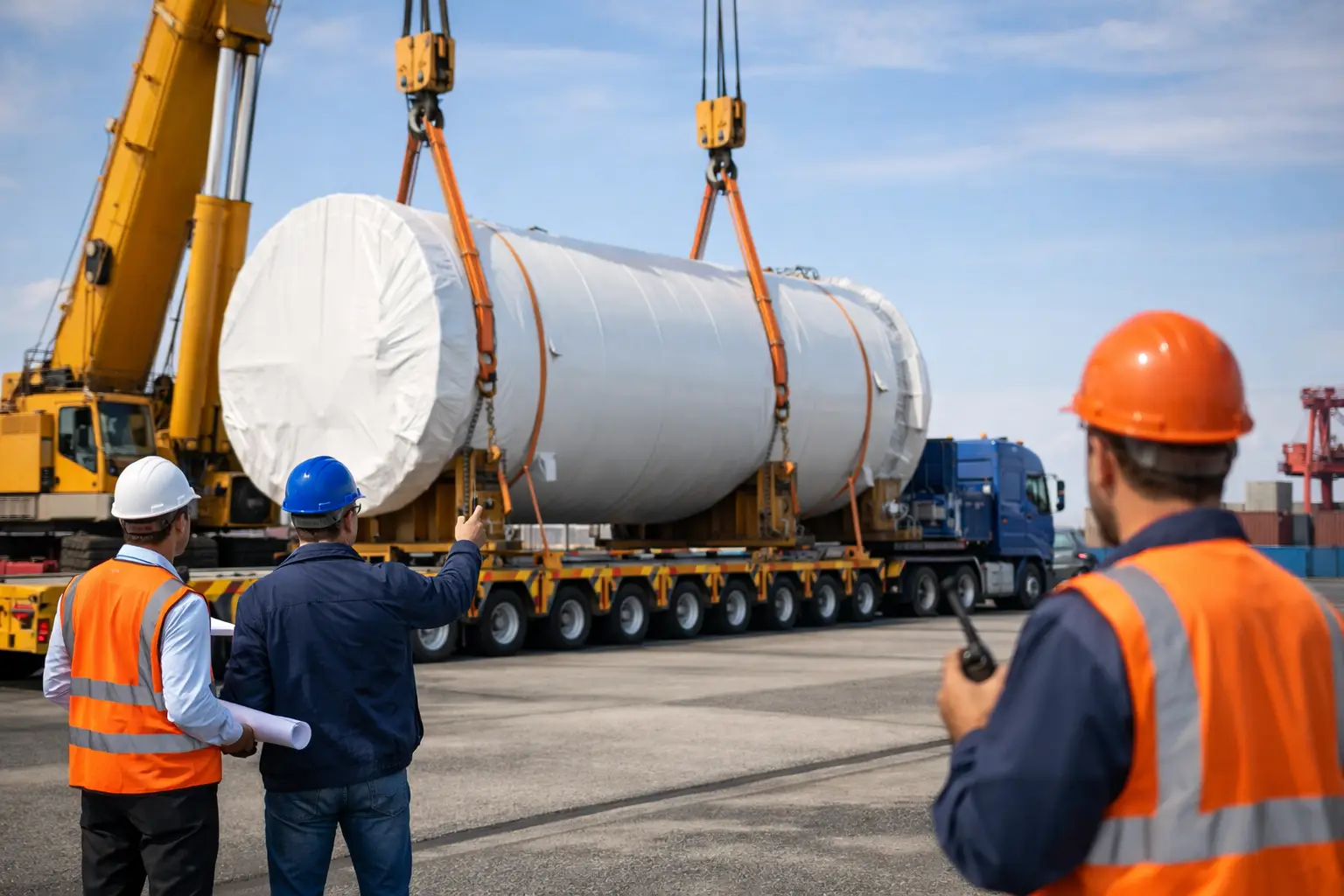
A 62,000-pound industrial press does not become a manageable shipment because a truck has been booked. This oversized shipment planning example shows how an operations team can turn a high-risk move into an executable plan - before the equipment leaves the facility.
The scenario involves moving a crated press from a manufacturer near Toronto to a plant expansion site outside Kansas City, Missouri. The shipment measures 38 feet long, 12 feet 4 inches wide, and 14 feet 2 inches high after it is loaded. Its dimensions exceed standard legal limits in multiple jurisdictions, and the combined gross vehicle weight will require weight analysis and permits. The receiving site has a fixed delivery appointment, limited staging space, and a crane crew scheduled for the following morning.
That combination creates the real challenge. Equipment selection, permits, route restrictions, border documentation, securement, and final-mile site conditions must support the same delivery plan. If one element changes, the rest may need to be reworked.
Start With Verified Freight Details
Oversized planning begins with measurements that can be used for permit applications and equipment selection. Estimated dimensions are useful during quoting, but they are not sufficient for execution. The shipper should provide verified length, width, height, weight, center of gravity, lifting points, and any handling restrictions before the carrier is dispatched.
In this example, the press is 38 feet long and 12 feet 4 inches wide. The packaged height of 14 feet 2 inches is especially significant because deck height directly affects the final loaded height. A standard flatbed may be available, but it may create clearance issues that a lower-deck option avoids.
The freight also has an offset center of gravity due to the internal press assembly. That affects where the load sits on the trailer, how weight is distributed across axles, and the securement plan. A shipment can be within its total weight target yet still be noncompliant if individual axle groups are overloaded.
Before equipment is assigned, confirm whether the dimensions represent the item itself or the fully prepared shipping condition. Skids, protective framing, tarps, lifting fixtures, and loading supports can add critical inches or thousands of pounds.
Select Equipment Based on the Actual Constraint
For this move, a double-drop or lowboy trailer is the likely starting point because reducing deck height helps manage loaded height. The final selection depends on the press's ground clearance, loading method, axle requirements, and route permit conditions. A step-deck may work for some tall freight, while a removable gooseneck trailer may be necessary when equipment must be driven or rolled onto the deck.
The right trailer is not always the lowest-cost option. A standard flatbed may have more readily available capacity, but if it pushes the load above a route's practical height limit, the apparent savings disappear through rerouting, utility coordination, or permit delays.
The planner should also determine whether the shipment needs a tarp system or a Conestoga-style solution. For a load this wide, enclosed protection may not be feasible. If weather protection is required, the packaging must be engineered to withstand exposure and the chosen covering must not increase the permitted dimensions beyond what has been planned.
Securement must match the commodity, trailer configuration, and regulations. The carrier will typically use chains, binders, blocking, bracing, and edge protection as appropriate. The shipper's role is to disclose approved tie-down points and restrictions. Never assume a crate can be secured by wrapping chains around structural members that were not designed for that purpose.
Build the Route Before Booking the Delivery Time
The route for oversized freight is not simply the fastest highway path. It is a reviewed operating corridor that accounts for bridge clearances, posted weight limits, construction activity, lane widths, interchange geometry, toll restrictions, and permit rules in every state or province involved.
For the Toronto-to-Missouri example, the planning team first identifies the border crossing and the Canadian and U.S. jurisdictions along the intended route. Permit requirements vary by location and by dimension. A load that is acceptable on one interstate corridor may require a different route or travel window in the next state.
Height deserves special attention. The loaded height of 14 feet 2 inches may clear many highway structures, but a route cannot be approved based on general assumptions. Construction zones, older overpasses, local detours, and private access roads can introduce lower clearances. The route review should extend through the final delivery approach, including the road leading into the plant.
This is also where escorts may enter the plan. At 12 feet 4 inches wide, the shipment may require pilot cars in certain jurisdictions or under specific permit conditions. Escort requirements can depend on width, length, height, route type, and time of travel. They should be confirmed early because qualified escort availability can affect the pickup date.
A practical route plan includes primary and contingency options. A road closure, accident, or weather event can be disruptive for any truckload, but an oversized load cannot always take the next exit and use local roads. The alternate must be permitted or capable of being permitted before it is needed.
Coordinate Permits and Cross-Border Documents in Parallel
Permits should be treated as a workstream, not an administrative task left until the truck is loaded. The permit provider needs accurate equipment details, axle spacing, axle weights, overall dimensions, origin, destination, and proposed route. Changes to trailer configuration or load placement can require revised permits.
In this example, the cross-border move adds customs documentation to the execution plan. The commercial invoice, packing details, commodity description, value, consignee information, and customs clearance instructions must align with the physical shipment. The driver should not arrive at the border with paperwork that describes the press as a generic machine if the documents and customs entry require more specific classification or details.
Border timing also affects permit planning. Some jurisdictions limit oversized travel during peak traffic periods, weekends, holidays, or nighttime hours. The shipment may need to be staged near the border or scheduled to cross during a window that supports both customs clearance and the next permitted travel period.
The best approach is to set a realistic delivery range rather than promising a standard transit time too early. Permits, weather, border processing, and travel-hour restrictions all affect the final schedule. A precise appointment can be set after the route, permits, and operating windows are confirmed.
Plan Pickup and Delivery as Separate Projects
Oversized freight often fails at the first or last mile, not on the highway. At pickup, the manufacturer must confirm the loading area can accommodate the tractor, specialized trailer, loading equipment, and required turning space. The facility needs a clear path from the press to the trailer, along with qualified personnel to load and inspect the shipment.
For this move, the manufacturer uses a gantry system to lift the press. The logistics team schedules the truck after verifying gantry availability, load readiness, and the estimated time needed to position and secure the freight. Loading should include a documented inspection of dimensions, securement, visible condition, and final axle weights where required.
The Missouri delivery site requires just as much preparation. The consignee confirms that its entrance can handle the tractor-trailer combination and that no parked vehicles, temporary fencing, or construction materials restrict access. The crane crew, riggers, and receiving supervisor receive the delivery window, trailer type, shipment dimensions, and unloading sequence in advance.
A common mistake is scheduling a crane for a fixed time without allowing for permitted travel restrictions. If the truck must stop outside the metro area until a permitted entry window opens, an early-morning crane appointment may be unrealistic. In this case, the shipment is delivered to a secure staging location the afternoon before and moved to the plant during the approved morning window.
Use a Single Execution File
Complex moves need one current source of information. The file should contain verified freight specifications, equipment details, permit numbers and conditions, route instructions, escort contacts, customs status, pickup and delivery contacts, site notes, and escalation procedures. It also needs version control. An old dimension sheet can create a costly dispatch error.
Communication should follow the operating milestones: equipment confirmed, permits approved, freight loaded, border cleared, daily location updates, arrival at staging, and final delivery. The goal is not to overwhelm stakeholders with messages. It is to give the shipper and consignee the information needed to protect labor schedules, site access, and production plans.
Midemide Logistics coordinates specialized and oversized freight with the equipment flexibility and cross-border oversight required for moves where ordinary truckload processes are not enough. For shippers, the practical standard is simple: do not approve the move until the load, route, permits, and delivery site have been planned as one connected operation.