
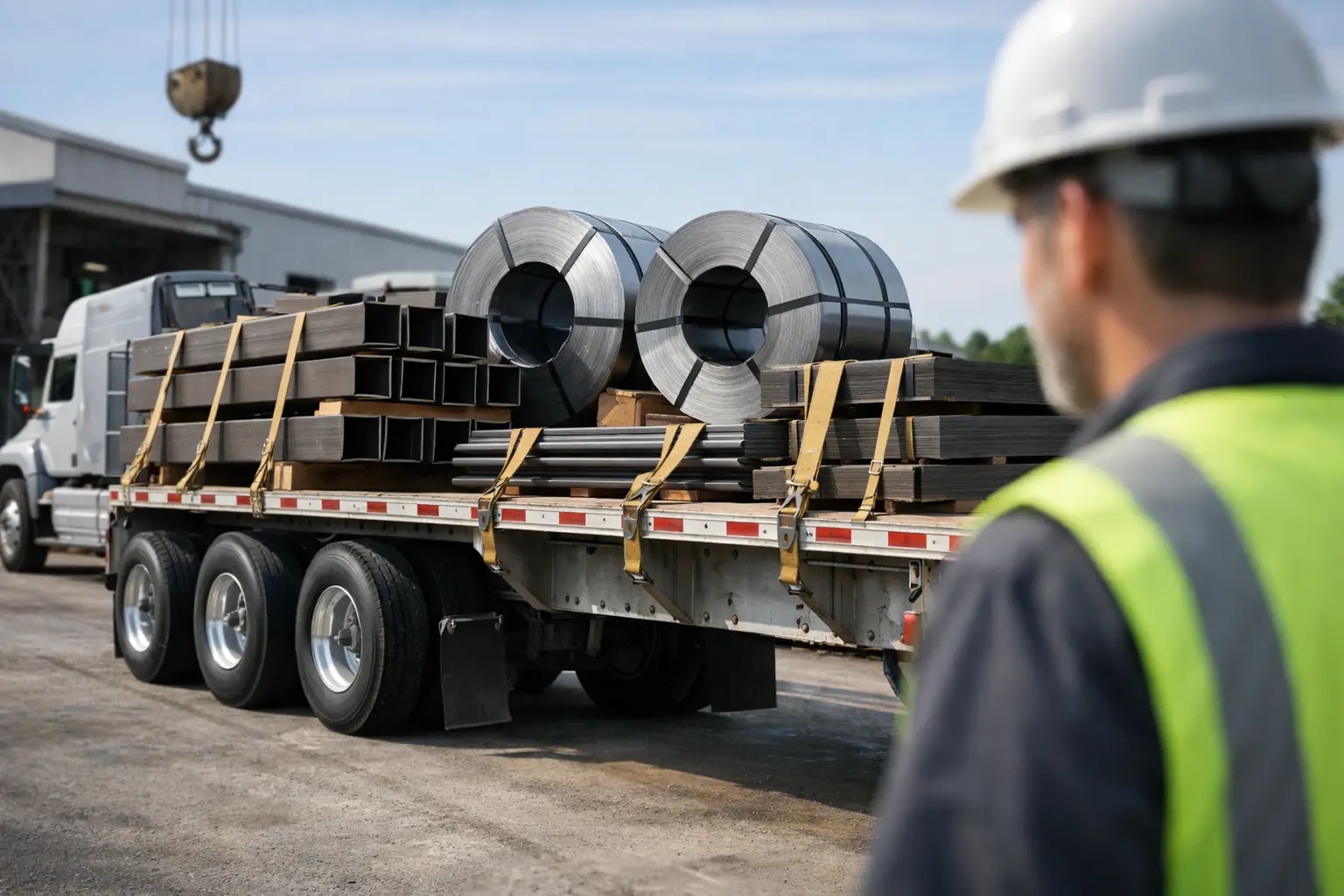
A steel shipping example is most useful when it reflects the details that create real transportation risk: weight distribution, loading method, securement, delivery timing, and border documentation. Steel is rarely a standard freight move. A shipment can look straightforward on paper, then require different equipment, a revised pickup plan, or a split load once the actual dimensions and weights are confirmed.
Consider a manufacturer in the Greater Toronto Area shipping fabricated steel coils to a customer in Tennessee. The order includes eight coated steel coils, each weighing approximately 4,500 pounds. The freight must move on a flatbed, cross the Canada-US border, and arrive within a scheduled receiving window so the consignee can maintain production.
This scenario shows why detailed planning before dispatch is more valuable than trying to correct problems after a truck arrives.
Steel Shipping Example: The Shipment Profile
The total commodity weight is 36,000 pounds, but weight alone does not determine the transportation plan. The shipper must also confirm each coil's width, outside diameter, eye orientation, packaging, loading sequence, and whether the coils require cradles, coil racks, timbers, or other loading materials.
For this example, the coils are loaded with their eyes oriented to the side in steel coil racks. Each coil is protected from direct contact with adjacent freight and positioned to support stable axle distribution. The shipping team provides the carrier with the following information before equipment is assigned:
| Shipment detail | Example requirement | | --- | --- | | Commodity | Coated steel coils | | Total weight | 36,000 pounds | | Pieces | 8 coils | | Equipment | 48-foot or 53-foot flatbed with coil racks | | Origin | Greater Toronto Area, Ontario | | Destination | Tennessee manufacturing facility | | Service | Cross-border, appointment delivery |
A standard dry van may be appropriate for some packaged steel products, but it is not the right default for exposed coils that need specific loading access and securement. A flatbed gives the shipper and driver the ability to inspect the load during pickup, apply required tie-downs, and verify that the shipment is positioned correctly before departure.
Equipment selection still depends on the cargo. A Conestoga may be preferred when a steel load needs flatbed accessibility but also requires weather protection. A step deck may be necessary for tall fabricated components. When a shipment exceeds legal width, height, length, or weight limits, specialized equipment and permit planning become part of the move rather than an afterthought.
Start With Accurate Freight Details
The most common preventable problem in steel transportation is incomplete shipment data. A booking that says steel coils, 36,000 pounds is not enough for a carrier to assign the right truck and build a compliant load plan.
The freight description should state the product type, piece count, individual weights, dimensions, packaging, and handling requirements. If a coil cannot be stacked, if a crane is required, or if the loading facility has a strict appointment process, that information needs to be communicated before pickup. The same applies to unloading. A receiver that only unloads from one side of the trailer or requires drivers to check in before 8:00 a.m. can create costly delays if the carrier is not prepared.
Weight distribution needs special attention. Even when total cargo weight is within normal highway limits, the placement of heavy coils or fabricated steel can create axle-weight issues. A qualified carrier will evaluate how the freight is loaded across the trailer, not simply whether the total shipment weight appears acceptable.
For large or unusually dense shipments, splitting freight across two trucks may be the better operational decision. It adds transportation cost, but it can reduce exposure to rework, delays, noncompliance, or damage. The least expensive quote is not necessarily the lowest-cost move once missed production time and handling risk are considered.
Securement Is Part of the Transportation Plan
Steel freight can shift with braking, turns, vibration, and road conditions. Securement is therefore a core planning requirement, not a task reserved for the driver at the dock.
In this steel shipping example, the coils are placed in appropriate racks and restrained using securement methods suitable for the commodity, equipment, and applicable regulations. The carrier verifies the condition and capacity of tie-down equipment, edge protection where needed, and the stability of the freight before leaving the origin. The shipper's loading team also has a role: cargo must be loaded in a manner that allows proper securement and does not conceal damage or create an unsafe configuration.
This is especially important with steel products that have smooth surfaces, concentrated weight, sharp edges, or irregular shapes. Steel plate, pipe, beams, machinery frames, and fabricated assemblies each present different handling considerations. A securement approach that works for bundled pipe may not be appropriate for coil, structural members, or oversized fabricated components.
Weather is another variable. Rain, ice, and road spray can affect certain steel products and can create hazardous conditions during loading and unloading. If corrosion protection or dry delivery is required, a Conestoga or other covered solution may offer a better balance between protection and loading flexibility.
Build the Cross-Border Process Before Pickup
Cross-border steel freight requires more than a truck heading south from Ontario. Border delays can affect delivery appointments, driver hours, and downstream production schedules, particularly when documentation is incomplete or shipment data does not match the paperwork.
For the Tennessee delivery, the shipper prepares a complete bill of lading, commercial invoice, packing details, accurate product descriptions, country-of-origin information, and the proper classification data required for customs processing. The carrier, customs broker, shipper, and consignee should be aligned on who is responsible for each document and when it must be submitted.
Steel products may also be subject to trade requirements that vary by product type, origin, and destination. Shippers should confirm current requirements with their customs and trade compliance resources instead of assuming that all steel moves follow the same process. A logistics provider can coordinate the freight movement, but commodity classification and trade compliance details must be accurate before the truck reaches the border.
Timing matters as much as paperwork. If pickup occurs late in the day, the carrier may not reach the border during the expected processing window. If the consignee has a fixed appointment, the route plan needs enough time for border clearance, traffic, fuel stops, required rest periods, and unexpected disruptions.
Coordinate Pickup, Transit, and Delivery as One Move
A steel shipment is only successful when the handoffs work. The origin needs the right equipment at the right time, the driver needs clear loading instructions, and the receiver needs accurate arrival communication.
For this example, the transportation coordinator confirms the pickup appointment, equipment type, rack availability, commodity details, and destination appointment before dispatch. Once loaded, the carrier provides shipment status updates at meaningful points: pickup completed, border crossing status, significant exceptions, and estimated delivery time.
That visibility allows the Tennessee receiver to plan labor and unloading equipment. It also gives the shipper time to respond if a border hold, weather event, mechanical issue, or appointment change affects the schedule. For production-sensitive freight, a dedicated transportation option can provide greater control over equipment, route expectations, and delivery timing. For less urgent loads, a planned spot or contract flatbed move may be more economical.
The right choice depends on shipment frequency, lane consistency, delivery consequences, and the level of control required. Businesses shipping steel every week between Ontario and the US may benefit from a repeatable carrier plan. Companies moving occasional project freight may need flexible capacity and specialized equipment support instead.
What This Example Reveals About Steel Freight
The shipment did not become complicated because it crossed a border. It was complex from the beginning because the cargo required exact information, suitable equipment, safe securement, and coordinated execution across several parties.
Midemide Logistics supports shippers moving standard and specialized freight across Canada and the United States, including flatbed, Conestoga, dedicated, oversized, and cross-border transportation. For steel loads, the planning conversation should begin with the physical freight and the delivery requirement, then work backward to the equipment and service model.
Before the next steel load is tendered, verify the piece-level weights, dimensions, loading method, securement needs, documents, and receiving constraints. Those details give the transportation plan a much better chance of performing as expected when the truck reaches the dock.