
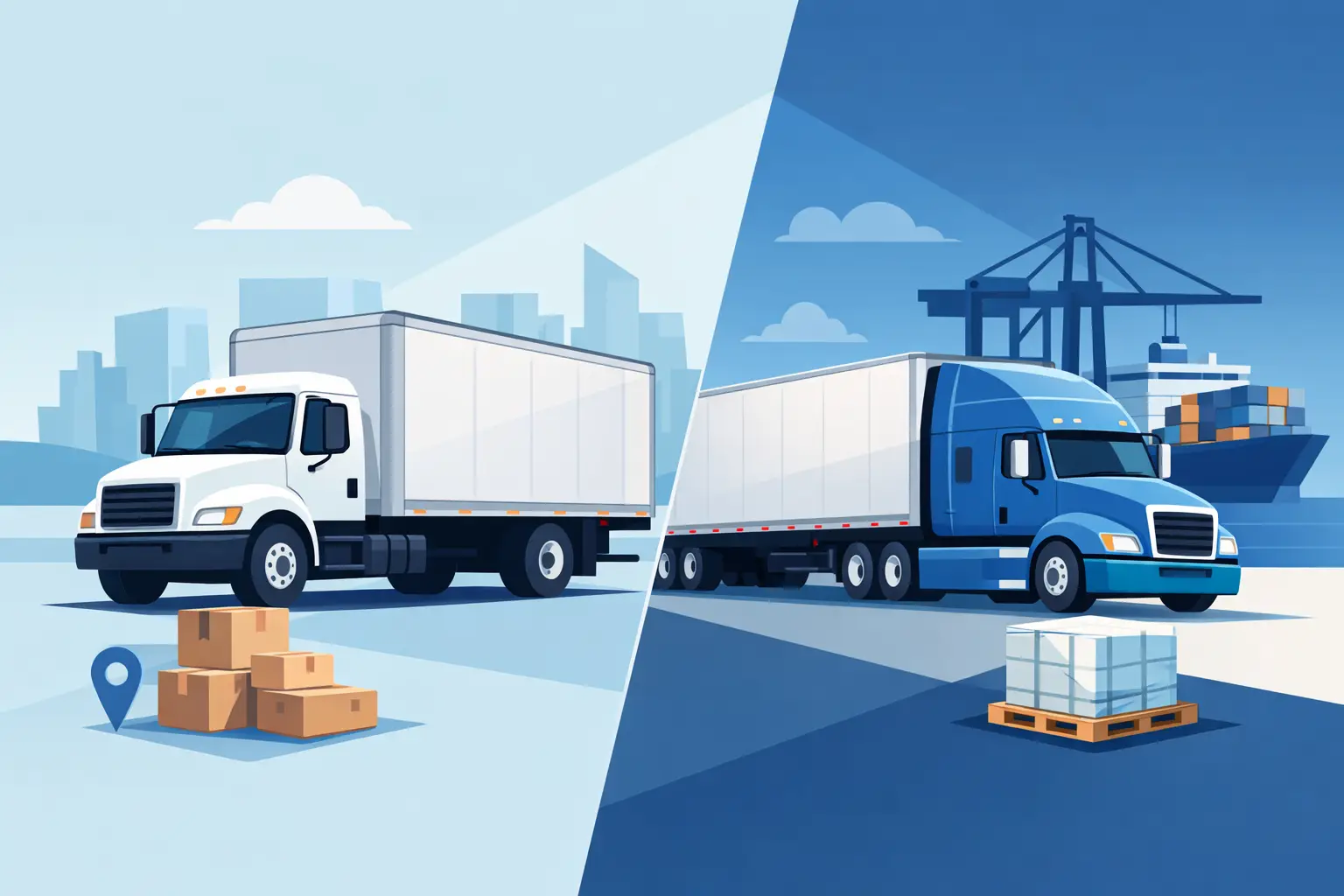
A straight truck vs trailer decision can change far more than the vehicle arriving at the dock. It affects how much freight can move per trip, whether the driver can access the delivery point, how quickly freight can be unloaded, and whether a shipment stays on schedule. For shippers managing retail replenishment, industrial materials, final-mile deliveries, or cross-border freight, selecting the right equipment starts with the real operating conditions of the load.
A trailer offers the capacity and long-haul efficiency needed for many full truckload moves. A straight truck can be the more practical choice when delivery locations are constrained, shipment volumes are smaller, or freight requires a liftgate and closer handling at the destination. The best option is not always the largest piece of equipment. It is the one that matches the freight, lane, site conditions, and service requirements.
Straight Truck vs Trailer: The Core Difference
A straight truck is a single vehicle where the cab and cargo body are mounted on one chassis. Common examples include cube vans, 5-ton trucks, and larger straight trucks with enclosed box bodies. Depending on the configuration, a straight truck may include a liftgate, pallet jack, temperature control, or other delivery equipment.
A trailer move generally involves a tractor pulling a separate trailer. Dry vans, refrigerated trailers, flatbeds, step decks, Conestoga trailers, and specialized equipment all fall within this category. The tractor and trailer configuration creates substantially more cubic capacity and payload potential than a standard straight truck.
This structural difference drives the operational trade-off. Trailers are designed to move larger freight volumes efficiently over regional and long-distance lanes. Straight trucks are designed for flexibility, tighter access, and delivery environments that do not work well for a conventional tractor-trailer.
When a Straight Truck Is the Better Freight Option
Straight trucks are often selected for shipments that fall between parcel delivery and full truckload freight. They provide dedicated vehicle capacity without requiring a shipper to pay for a 53-foot trailer when the load does not justify it.
They are particularly useful for final-mile and urban deliveries. A driver may need to navigate congested streets, industrial parks with tight turns, older downtown loading zones, or retail locations with limited dock space. A straight truck generally has a shorter overall length and can maneuver more easily than a tractor-trailer.
A liftgate is another key reason to use a straight truck. Many receivers do not have a loading dock, forklift, or dock-height access. This is common at retail stores, medical facilities, construction sites, commercial offices, and certain warehouses. With a liftgate-equipped straight truck, freight can be lowered safely to ground level rather than requiring the receiver to provide unloading equipment.
Straight truck service can also support multi-stop routes efficiently. A distributor delivering pallets to several locations across a city may need a truck that can enter each site, unload quickly, and keep moving. The delivery sequence, pallet configuration, and unloading requirements often matter more than maximum trailer capacity on these routes.
For cross-border shipments, straight trucks can be a practical option for time-sensitive regional deliveries between the United States and Canada. The equipment still requires proper customs documentation and shipment planning, but a smaller, dedicated vehicle may be well suited to urgent freight moving to a receiver with restricted access.
When a Trailer Delivers Better Value
A trailer is usually the stronger choice when freight volume, weight, or distance makes consolidation worthwhile. A 53-foot dry van can move a large number of pallet positions in one trip, helping reduce the cost per unit for full truckload shipments. For manufacturers, wholesalers, and distribution centers shipping dock-to-dock, this is often the most efficient model.
Trailer service also offers more equipment variety. A dry van protects standard palletized goods from weather and road exposure. Refrigerated trailers support temperature-controlled products. Flatbeds and Conestogas accommodate freight that is oversized, difficult to load through rear doors, or requires side loading. Step decks, double drops, and specialized trailers can support loads with unusual dimensions or weights.
Longer distances tend to favor trailer capacity. When freight is moving from a plant to a regional distribution center, across several states, or between major Canadian and U.S. markets, a trailer can carry more product with fewer vehicle movements. That can improve transportation efficiency, reduce handling, and simplify appointment scheduling at dock-equipped facilities.
A trailer is also often the right solution for predictable, recurring freight. Dedicated transportation programs may use trailer equipment to serve routine lanes, scheduled plant transfers, or retail replenishment networks. When shipment patterns are consistent, equipment can be matched to the lane, loading process, and delivery windows with greater precision.
Capacity Is More Than Pallet Count
Pallet count is a useful starting point, but it should not decide the equipment on its own. Freight density, product dimensions, stackability, packaging strength, and weight distribution all affect what can safely move on a straight truck or trailer.
A shipment of lightweight boxed products may cube out before reaching the vehicle's weight limit. Dense industrial components, however, may reach a legal payload limit with much less floor space used. Freight that cannot be double stacked may require more linear feet than its pallet count suggests. Long pieces, machinery, crated equipment, and irregularly shaped products may need flatbed or specialized trailer service even if the total weight is relatively low.
Shippers should also consider axle weights and load balance. A load that fits physically may still require adjustment to distribute weight correctly. This matters for safe handling, legal compliance, and avoiding delays at the point of pickup. Accurate dimensions, weight, commodity descriptions, and loading requirements allow the carrier to assign equipment that is appropriate from the start.
Delivery Access Often Decides the Equipment
The destination can be more important than the origin when choosing between a straight truck and trailer. A shipper may load a 53-foot trailer easily at a distribution center, only to find that the receiver has no room for it to turn, back in, or park while unloading.
Before booking equipment, review whether the receiver has a dock, dock height, forklift, delivery appointment, truck access restrictions, and room for a tractor-trailer. Confirm whether the location has residential, municipal, or time-of-day restrictions. Construction sites may require ground-level unloading and advance coordination with site personnel. Retail deliveries may require a liftgate, pallet jack, and a driver who can work within a limited delivery window.
These details help prevent common accessorial costs and service failures, including attempted deliveries, detention, re-delivery, or the need to transfer freight to a smaller vehicle. Planning the final mile early is usually less expensive than fixing an equipment mismatch after the load is already in transit.
Cost Comparison: Look Beyond the Rate
A straight truck may have a higher cost per pallet than a fully utilized trailer, especially on longer lanes. However, it can be less expensive overall when it prevents the use of unnecessary capacity or avoids final-mile complications. Paying for a trailer that cannot access the receiver can create more cost than selecting a straight truck from the beginning.
Conversely, using several straight trucks to move a high-volume shipment may cost more than one properly loaded trailer. It can also create additional appointments, handling events, and tracking points. Trailer service generally produces better economics when a shipper can consolidate freight and use the available space efficiently.
The full comparison should include linehaul, fuel, border requirements where applicable, liftgate needs, driver assistance, detention risk, appointment requirements, and potential delivery restrictions. Freight planning should evaluate total landed transportation cost and delivery reliability, not only the initial quoted rate.
A Practical Equipment Selection Process
Start with the freight profile: total weight, dimensions, pallet count, stackability, commodity type, and any temperature, securement, or handling needs. Next, review the route and delivery environment, including loading method, receiver access, dock availability, and required delivery date.
A straight truck is typically a strong fit for smaller dedicated loads, liftgate deliveries, multi-stop routes, and restricted urban or commercial sites. A trailer is typically a strong fit for dock-to-dock freight, high-volume loads, long-haul lanes, and specialized equipment needs. If the shipment includes oversized machinery, construction materials, or freight that requires open-deck loading, the decision may not be straight truck versus dry van at all. It may require flatbed, Conestoga, or another specialized trailer configuration.
For businesses moving a mix of freight, working with one logistics partner can simplify these decisions. Midemide Logistics coordinates straight truck, trailer, final-mile, flatbed, Conestoga, specialized, and cross-border freight solutions based on the practical requirements of each move.
The most reliable equipment decision comes from treating the delivery site as part of the load plan. When freight dimensions, handling needs, and destination access are confirmed before dispatch, the shipment has a much better chance of arriving with the right vehicle, the right service level, and fewer avoidable exceptions.