
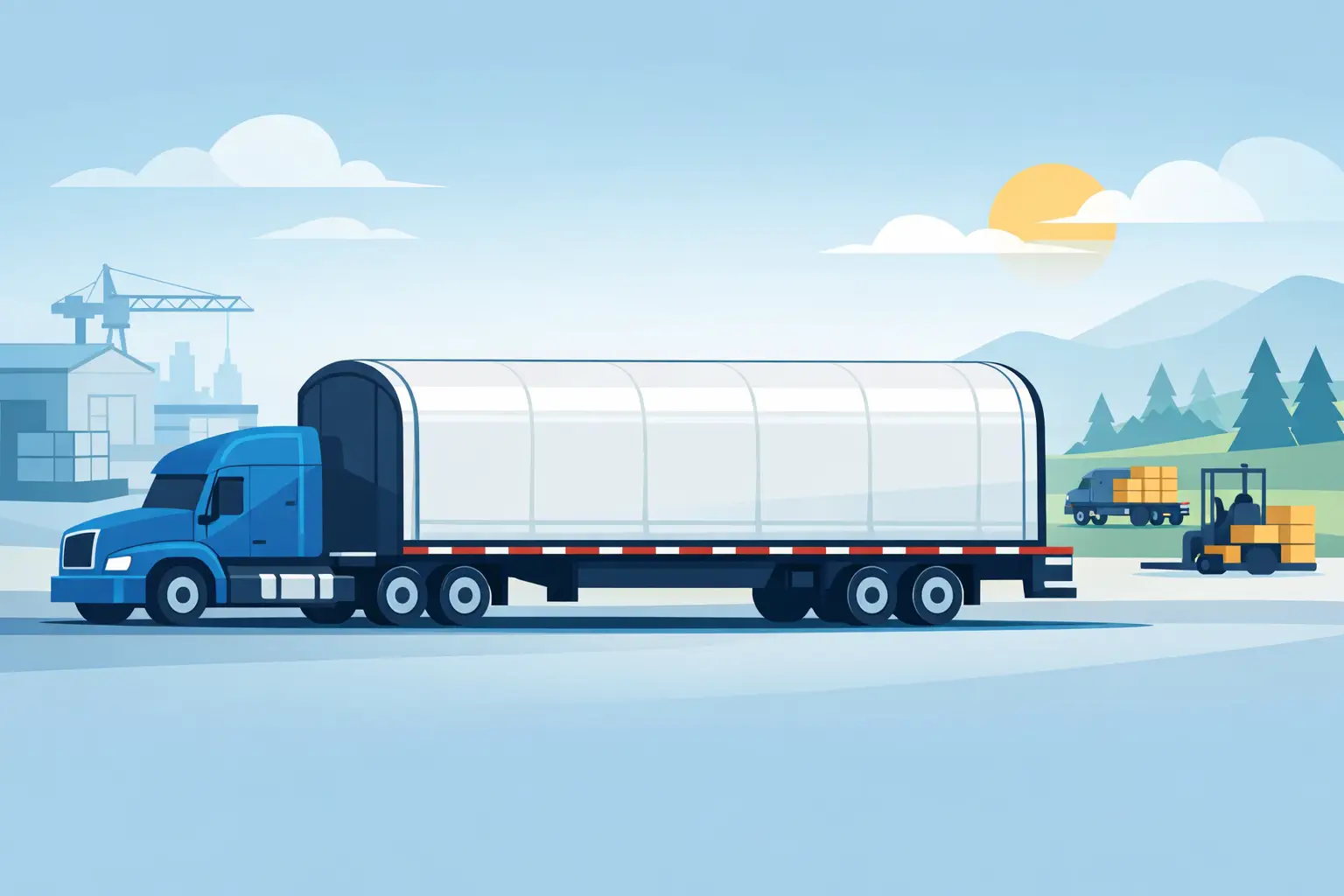
A missed loading appointment can disrupt an entire production schedule, especially when freight cannot be loaded through a standard rear trailer door. When shippers ask, "what is Conestoga trailer equipment used for?" the practical answer is simple: it provides flatbed-style access while protecting freight from rain, road debris, and other exposure.
A Conestoga trailer is a flatbed trailer fitted with a rolling tarp system mounted on a steel frame. The tarp retracts toward the front or rear of the trailer, exposing the deck and sides for loading. Once freight is secured, the system closes around the load to create weather protection without the fixed walls of a dry van.
For manufacturers, distributors, and construction-related shippers, this equipment can solve a common freight problem: cargo needs side or overhead loading, but it also needs protection during transit. It is widely used across the United States and Canada for industrial, commercial, and cross-border shipments.
What Is a Conestoga Trailer and How Does It Work?
The name comes from the covered wagons associated with Conestoga, Pennsylvania. In freight transportation, however, a Conestoga is not a wagon-style trailer. It is specialized flatbed equipment designed to combine cargo access with enclosed protection.
The trailer starts with a standard flatbed platform. Over that deck sits a series of hoops or bows connected to a movable tarp. The tarp rolls on a track, allowing the driver to open the trailer from the side, either end, or across the top. This gives loading crews room to use forklifts, cranes, or overhead lifting equipment.
After loading, the freight is secured to the deck with the appropriate chains, straps, edge protection, blocking, and bracing. The tarp system is then rolled closed and tensioned. The covering protects the cargo, but it is not the primary freight-securement method. Cargo must still be properly secured to meet applicable transportation requirements.
Conestoga configurations vary by carrier and trailer type. Common options include standard flatbed Conestogas, step-deck Conestogas for taller freight, and double-drop units for specialized dimensional loads. Interior height, usable deck length, weight capacity, and door access can differ, so equipment should be matched to the shipment rather than selected by name alone.
Why Shippers Use Conestoga Equipment
The primary benefit is flexibility. A dry van offers full enclosure but typically limits loading to the rear doors. An open flatbed allows broad loading access but leaves freight exposed unless it is tarped manually. A Conestoga provides access similar to a flatbed while reducing the handling and transit risks associated with conventional tarping.
For many operations teams, faster loading is the immediate advantage. A side-loaded palletized shipment can be placed directly onto the trailer without requiring workers to maneuver freight through a narrow rear opening. Long machinery, crated components, steel fabrications, and awkward industrial products can also be loaded by crane from above.
The rolling tarp system can improve consistency at pickup and delivery. Manual tarping takes time, requires space around the trailer, and may be difficult in poor weather. With a Conestoga, the driver can generally open and close the system more efficiently, although safe operating space and site conditions still matter.
Conestoga trailers are frequently considered for freight such as:
- Machinery, equipment, and fabricated industrial components
- Palletized building materials and construction products
- Steel, aluminum, and non-sensitive metal products
- Crated freight that requires side or overhead loading
- Packaged goods that need weather protection but do not require a sealed dry van
This does not mean every protected shipment belongs on a Conestoga. Freight sensitivity, loading method, delivery site restrictions, dimensions, and available capacity all affect the right decision.
Conestoga Trailer vs. Flatbed vs. Dry Van
The equipment choice often comes down to the trade-off between access and protection. A standard flatbed is usually the best fit when cargo can safely travel exposed or when manual tarps are acceptable. It can also be easier to source on certain lanes. However, tarping adds labor, can increase loading time, and may not provide the same level of coverage as a rolling tarp system.
A dry van is a strong choice for dock-loaded, palletized, non-oversized freight that needs a fully enclosed trailer. Its fixed walls and roof protect cargo and can provide greater security. The limitation is loading access. Freight that is too long, too tall, or impossible to load through the rear doors may require another solution.
A Conestoga sits between these options. It is especially valuable when a shipment requires flatbed loading methods and protection from weather. It may cost more than a standard flatbed on some lanes because trailer availability is more limited. It also may not be suitable for cargo that requires a fully sealed environment, temperature control, or a high-security dry van configuration.
The right comparison is not simply trailer rate versus trailer rate. Shippers should consider total execution cost, including loading labor, tarping time, cargo exposure, appointment windows, damage risk, and the consequences of a delayed shipment.
Freight That Requires Extra Planning
Although Conestoga equipment is versatile, it has physical limits. The tarp system has clearance restrictions, and freight cannot interfere with the bows, roof structure, or movement of the tarp. A shipment may fit on an open flatbed but still be too tall or too wide for a standard Conestoga configuration.
Weight distribution matters as well. A load may be within the trailer's total payload capacity but still require repositioning to meet axle-weight requirements. Long, heavy, or unusually shaped freight should be reviewed before dispatch, particularly when crane loading, specialized securement, permits, or escorts may be involved.
Cross-border shipments add another planning layer. Commercial documents, cargo descriptions, customs coordination, pickup timing, and delivery commitments should align before the truck arrives. Equipment selection should support the freight plan, not create additional friction at the border or destination.
Shippers should provide accurate details during quoting: commodity, dimensions, weight, packaging, pickup and delivery access, loading method, required securement, and any protection requirements. Photos are often useful for machinery, fabricated pieces, or freight with irregular shapes. These details help a logistics provider confirm whether a standard Conestoga, step-deck Conestoga, or another specialized trailer is needed.
Questions to Ask Before Booking a Conestoga
Before assigning a shipment to a Conestoga trailer, confirm how the freight will be loaded and unloaded. Can the facility load from the side or above? Is there enough clearance and staging space for the tarp system to open? Does the consignee have a dock, forklift, crane, or other unloading equipment?
Next, determine the actual protection requirement. If the freight must remain completely enclosed and secured from unauthorized access, a dry van may be the better choice. If the product can travel on an open deck but cannot be exposed to rain or road conditions, Conestoga equipment is often a practical fit.
Finally, review timing and capacity early. Specialized equipment is not equally available in every market, and cross-border lanes can require more advance coordination. Early planning gives carriers and brokers time to source the right trailer, validate dimensions, and avoid last-minute substitutions that do not meet the shipment's requirements.
For business-critical freight, the best equipment is the one that supports safe loading, reliable protection, compliant securement, and a realistic delivery plan. Midemide Logistics can coordinate Conestoga capacity alongside flatbed, specialized, and cross-border transportation options so the trailer choice fits the freight rather than forcing the freight to fit the trailer.